Your temperature gauge is climbing, or the engine has already boiled over and there’s steam under the bonnet. There are ten common engine overheating causes, some cheap to fix, some serious, and it is not safe to keep driving with the needle in the red. Below are the causes, grouped by what you actually notice first, so you can work out which one you’re dealing with before you decide what to do next.
What you are noticing
Overheating shows up in a few different ways, and the pattern you see is often the first clue to the cause:
- The gauge creeps up slowly, or shoots up fast
- A warning light or chime for engine temperature
- Steam, a sweet smell, or a hissing sound from under the bonnet
- The heater blows cold air even though the engine feels hot
- The coolant reservoir keeps getting lower with no visible leak
- A puddle of coloured liquid under the car after it’s been parked
- White smoke from the exhaust, or a milky film on the oil dipstick
What is usually causing it
1. The gauge climbs in traffic but is fine on the open road. This points to a weak or failed cooling fan. The fan’s job is to pull air through the radiator when the car isn’t moving fast enough to do it on its own, so it only struggles at low speed or standing still.
2. The gauge climbs everywhere, not just in traffic. A thermostat stuck closed is the usual reason. Coolant can’t get through to the radiator to shed heat, so it keeps recirculating through the hot engine block instead of cooling down. Heater behaviour on its own isn’t a reliable way to tell this apart from other faults, it can still blow warm, cold or hot depending on coolant level and circulation. What does point to a stuck thermostat is the gauge climbing steadily everywhere you drive, not just at low speed.
3. Coolant keeps disappearing from the reservoir with no puddle anywhere, or the heater suddenly turns cold while the gauge climbs. Both usually trace back to the water pump. The more common version is a weep hole leak: the pump is leaking externally, as it’s designed to once its seal wears, but the coolant lands on the hot engine block or a pulley and evaporates before it reaches the ground, so there’s nothing to find underneath. The more serious version is a failed impeller, where the pump stops moving coolant altogether, and the heater circuit is often affected first, so the heater goes cold almost immediately, with the engine overheating fast behind it. Low coolant on its own can cause the same cold-heater symptom, by letting an air pocket form in the system, so the coolant level is worth checking before assuming the pump has failed.
4. There’s a puddle or a sweet smell under the car. An external leak, from a hose, the radiator itself, or a pipe joint, is often the simplest of these ten to find and the cheapest to fix, provided it’s caught before the engine runs dry.
5. The gauge reads normal even though the car is clearly overheating, or the fan never comes on. A faulty coolant temperature sensor can send the wrong reading to the dashboard and to the fan control, which means the system doesn’t know it needs to react. This one is deceptive because the gauge itself looks fine.
6. The reservoir is visibly low and nobody’s topped it up. Sometimes the cause really is this simple: the coolant level dropped from a small leak or from normal loss over time, and it was never checked. Low coolant on its own can cause overheating even with no other fault present.
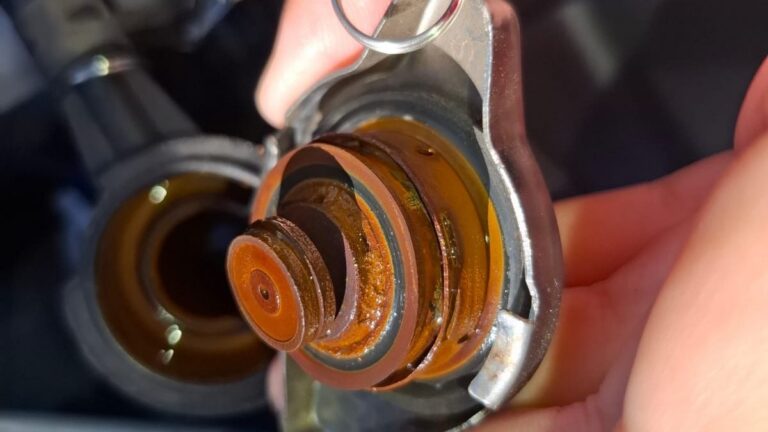
7. Hissing or steam from around the cap, or the cap won’t hold pressure. A properly working radiator cap raises the coolant’s boiling point by keeping the system pressurised. Once the seal on a defective cap fails, the system can’t hold that pressure, and the coolant boils at a lower temperature than it should.
8. A brand new cap still doesn’t stop the pressure loss. That points past the cap itself, most often to a dented or corroded radiator neck that the cap can no longer seal against, or a hairline crack in the expansion tank or elsewhere in the system letting pressure bleed away. Either way, coolant boils over for the same reason as cause 7, it just isn’t the cap causing it this time.
9. Milky oil on the dipstick, white smoke from the exhaust, or bubbles in the coolant. These point to a blown head gasket, which lets coolant and combustion gases mix where they shouldn’t. This is the most serious cause on this list and the one where driving on is riskiest.
10. The coolant looks old and rust coloured, and parts of the radiator feel hot in patches while others stay cool. This suggests a clogged radiator core, usually from a flush that’s overdue. Blocked passages stop coolant flowing evenly, so parts of the radiator do nothing while others take all the load.
What happens if you leave it
An engine that keeps running hot warps the cylinder head, damages the head gasket, and in the worst cases seizes the engine completely. A head gasket job runs into the thousands of rands. A seized engine usually means a replacement engine, not a repair. None of these get cheaper by waiting, and most of them get more expensive the longer the engine keeps running at the wrong temperature.
What to do now
- If the gauge is in the red or you see steam, pull over and switch off as soon as it’s safe.
- Do not open the radiator cap while the engine is hot. Pressurised coolant can scald you.
- Once the engine has cooled, check the coolant level in the reservoir and look underneath for a puddle.
- If the level is low and there’s no obvious leak, top up with the correct coolant and get the system checked rather than just driving on and hoping.
- If you see white smoke, smell burning coolant, or the oil looks milky, don’t restart the engine. Have it towed in.
Need someone to look at it now? Get in touch with either branch through fangioauto.co.za/contact-us and book a cooling system check.
What we do at Fangio
Both Fangio Auto Randburg and Fangio Auto Hermanus diagnose and repair cooling system faults, from a simple hose leak through to head gasket work. A diagnosis usually starts with a pressure test on the cooling system, which shows up leaks that aren’t visible when the engine is cold and idle. From there, the mechanic checks the thermostat, the fan operation, the water pump, and the coolant condition, and looks at the head gasket if the symptoms point that way. Straightforward jobs like a hose or a radiator cap can often be done same day. A head gasket job takes longer, since it means stripping down the top of the engine properly rather than rushing it. Every repair is backed by Fangio’s 12 month or 10 000 km labour warranty from the invoice date.
Questions people ask
Is it safe to drive with the temperature gauge rising?
No. Keep driving and you risk turning a cheap fix into a head gasket or engine replacement. Pull over once it’s safe to do so.
My engine overheats in traffic but is fine on the highway. What does that mean?
That pattern almost always points to the cooling fan, since the fan only matters when there isn’t enough airflow from driving speed alone.
Why is coolant disappearing from my reservoir with no puddle underneath?
It’s usually the water pump leaking from its weep hole, with the coolant evaporating on the hot engine block before it can reach the ground, or coolant being burned inside the engine. Both need a proper diagnosis, not just a top-up.
Why does my heater blow cold air when the engine is overheating?
This means coolant isn’t reaching the heater core properly, most often from low coolant, an air pocket in the system, or a water pump that’s stopped circulating. A stuck thermostat is usually a different pattern, the gauge climbs steadily everywhere you drive rather than the heater going cold. Either way, it needs a proper look rather than just a top-up.
What does milky oil on the dipstick mean?
It usually means coolant has mixed into the oil, most often from a blown head gasket, and needs attention straight away.
Book a cooling system check
Overheating rarely fixes itself, and the cause isn’t always the one you’d guess from the dashboard. Fangio Auto Randburg and Fangio Auto Hermanus both diagnose and repair cooling system faults, backed by a 12 month or 10 000 km labour warranty. Book online or get in touch through fangioauto.co.za/contact-us to choose your nearest branch.
Already have a quote?
Get an honest second opinion
Send it over and we’ll review it, explain it plainly, and beat it where we can.