Table of Contents
- Why car service kilometers aren’t one-size-fits-all
- Quick answer: how many km between car services
- Typical car service intervals by brand
- Why intervals differ between makes and models
- Time vs kilometres: which one matters more?
- Minor service vs major service checklist
- When to service your car early
- Hermanus and Overberg driving conditions
- Book a service check with Fangio Auto
Why car service kilometers aren’t one-size-fits-all
Ask five car owners how often they service their car and you’ll get five different answers. That’s because car service kilometers aren’t a single number. Your interval depends on the manufacturer, the engine, the age of the vehicle, how you drive, and what your warranty or service plan requires.
The good news is that you don’t need to memorise every figure. You just need to know how to find your interval, why it differs from your neighbour’s, and how to spot the signs that your car needs a service before the next milestone.
This guide walks you through the typical ranges, the difference between minor and major services, and the local conditions that quietly shorten how long a car can go between visits.
Quick answer: how many km between car services
Most modern cars sit somewhere between 10,000 km and 20,000 km between services, or once every 12 months, whichever comes first.
For a rough idea before you check your service book:
- Many Japanese and Korean brands sit closer to the 10,000 to 15,000 km range.
- Many European brands stretch out to 15,000 to 20,000 km.
- Older cars, diesels under heavy load, and cars that tow regularly often need shorter intervals.
Always confirm the exact number in your service book or owner’s manual. If you’re not sure how to read the schedule, ask Fangio Auto or your regular workshop to check it against your car’s age, mileage, and service history. The figures below are useful starting points, not rules. You can see what a car service at Fangio Auto covers before you book.
Typical car service intervals by brand
The table below is a general guide. Intervals shift between model, year, and engine type, so treat it as a starting point and verify against your vehicle’s service book.
| Brand / type | Typical service interval | Notes |
|---|---|---|
| Toyota (most models) | ~10,000 km or 12 months | Often shorter for older Hilux and Quantum models |
| Volkswagen, Audi | ~15,000 km or 12 months | Some long-life plans stretch further |
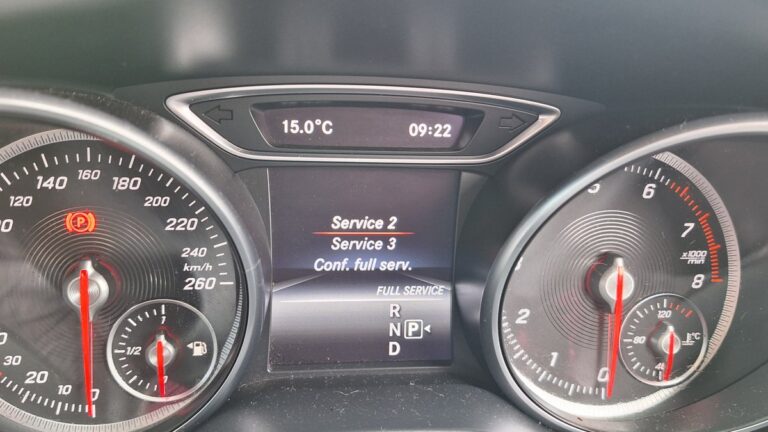
| BMW, Mercedes-Benz | ~15,000 to 25,000 km, condition-based | Onboard system flags service due |
| Volvo (newer models) | ~20,000 km or 12 months | Older Volvos can be shorter |
| Chrysler, Jeep, Dodge | ~12,000 km or 12 months | Heavy-use vehicles often need sooner |
| Hyundai, Kia | ~15,000 km or 12 months | Hyundai service intervals vary by model and year, so check your service book for model-by-model figures |
| Ford, Mazda | ~15,000 km or 12 months | Some diesels at 10,000 km |
| Older cars (10+ years) | ~10,000 km or 12 months | Worn engines benefit from shorter gaps |
| Diesel bakkies, tow vehicles | ~7,500 to 10,000 km | Heavy load, dust, and towing all shorten intervals |
If your vehicle is on a manufacturer service plan, stick to that plan’s exact figures so you don’t void the warranty.
Why intervals differ between makes and models
Two cars in the same parking lot can have very different service needs. Here’s why.
Engine design and oil specification. Some engines run hotter, some hold more oil, and some use long-life synthetic oils that can handle more kilometres before they break down. That alone can move an interval from 10,000 km to 20,000 km.
Driving conditions assumed by the manufacturer. Service intervals are usually written assuming “normal” driving. If your normal is short trips, dusty roads, gravel, or stop-start town traffic, the manufacturer’s normal isn’t your normal.
Age of the car. A car with 250,000 km on the clock will benefit from a fresh oil and filter sooner than a near-new car. Worn engines contaminate oil faster.
Diesel vs petrol. Diesel engines often work harder, soot up sooner, and need cleaner oil to keep the turbo healthy. That’s why some diesel intervals are shorter.
Fleet, taxi, and high-use vehicles. A car doing 60,000 km a year doesn’t care about the “12 months” rule. It will hit its kilometre mark first, sometimes twice in one year.
Time vs kilometres: which one matters more?
Most service schedules use the phrase “every 10,000 km or 12 months, whichever comes first”. The reason both numbers exist is simple. Oil ages even when the car isn’t driven.
If you do very low mileage, say a Hermanus retiree’s car that only does the school run and the shops, you might only cover 4,000 km in a year. The car still needs an annual service. Old oil thins, picks up moisture, and stops protecting the engine properly.
If you do very high mileage, like a sales rep covering 50,000 km a year, the kilometres will trigger the service long before the 12 months are up.
The simple rule: whichever number you hit first, that’s when to book.
Minor service vs major service checklist
A typical service plan alternates between minor and major services. Both matter.
Minor service usually includes:
- Engine oil and oil filter replacement
- Top-up of essential fluids
- Visual brake inspection
- Tyre pressure and tread check
- Wiper blade condition check and light check
- Battery test
- Quick under-bonnet inspection for leaks
Major service may add, depending on the vehicle’s service schedule:
- Air filter, fuel filter, and pollen filter replacement when due
- Spark plugs (petrol) or glow plugs (diesel) where due
- Brake fluid and coolant check or change
- Detailed brake inspection, including pads and discs
- Suspension and steering checks
- Drive belt and hose inspection
- Diagnostic scan for stored fault codes
At Fangio Auto, the service software and your vehicle’s service history guide what gets replaced at each visit. A good workshop will record what was done in your service book, so the next workshop knows what’s already been replaced.
When to service your car early
Sometimes you shouldn’t wait for the next service kilometre. Book sooner if you notice:
- A new warning light on the dash
- Knocking, ticking, or whining noises from the engine
- A noticeable drop in fuel economy
- A burnt-oil smell
- Smoke from the exhaust
- The car pulling, shaking, or feeling heavy under braking
- Oil that looks black and gritty on the dipstick well before the next service
- A long break since the last service, especially if the car has been sitting
Early servicing is almost always cheaper than waiting for the small problem to become a real repair. The South African Automobile Association and Arrive Alive both push regular servicing as one of the cheapest forms of road safety.
Hermanus and Overberg driving conditions
Local driving conditions affect car service kilometers more than most owners realise.
Around Hermanus and the wider Overberg, a few things quietly stress a car:
- Short trips around town. Engines that don’t reach full operating temperature build up moisture in the oil. That shortens oil life.
- Coastal air. Salt accelerates rust on brake hardware, exhaust components, and electrical connectors. A regular workshop check picks this up early.
- Dust and gravel. Farm roads and gravel detours load up the air filter faster than a city car would expect.
- Steep passes and hills. Pulling over Sir Lowry’s Pass or up Hemel-en-Aarde puts more work into brakes, gearbox, and cooling.
- Holiday cars that sit unused. Cars left for months gum up the fuel system, drain the battery, and degrade the oil even at low kilometres.
- Older fleet of family vehicles. Many cars in the area are well past 150,000 km. Sticking to factory intervals isn’t always enough.
If any of these apply to you, lean toward the shorter end of your manufacturer’s range, or chat to a workshop about a sensible local schedule. If you are comparing car service in Hermanus options, ask Fangio Auto to check your interval against your car’s age, mileage, and service history. For Randburg and Johannesburg owners, similar logic applies for stop-start traffic, highway commuting, and high summer temperatures.
Book a service check with Fangio Auto
Not sure where your car sits on the schedule? The simplest move is to bring it in for a quick check. We’ll look at your service book, run a basic inspection, and tell you honestly whether you’re due, overdue, or fine for another few thousand kilometres.
You can book at either branch using the details below, and we’ll match the work to what your car actually needs.
Ready to check where your car sits on the service schedule? Book a service check with Fangio Auto at either branch. Call Randburg on 011 326 3133 or WhatsApp 082 402 3517. Call Hermanus on 087 164 1041 or WhatsApp 060 616 2948. We’ll keep your car on the right car service kilometers schedule, no guesswork. Book Now.
Already have a quote?
Get an honest second opinion
Send it over and we’ll review it, explain it plainly, and beat it where we can.