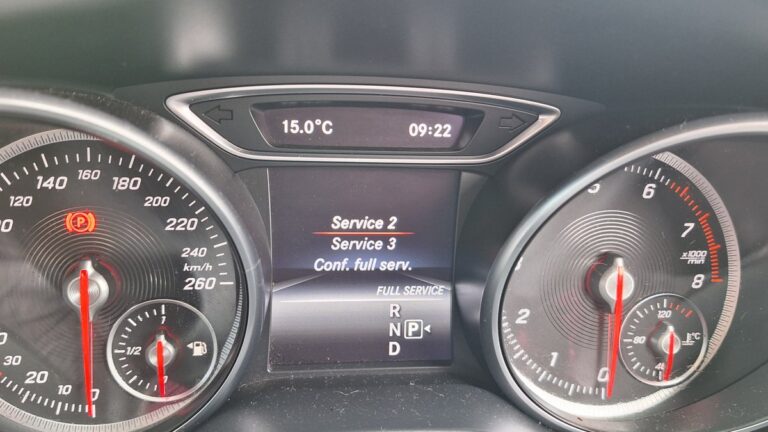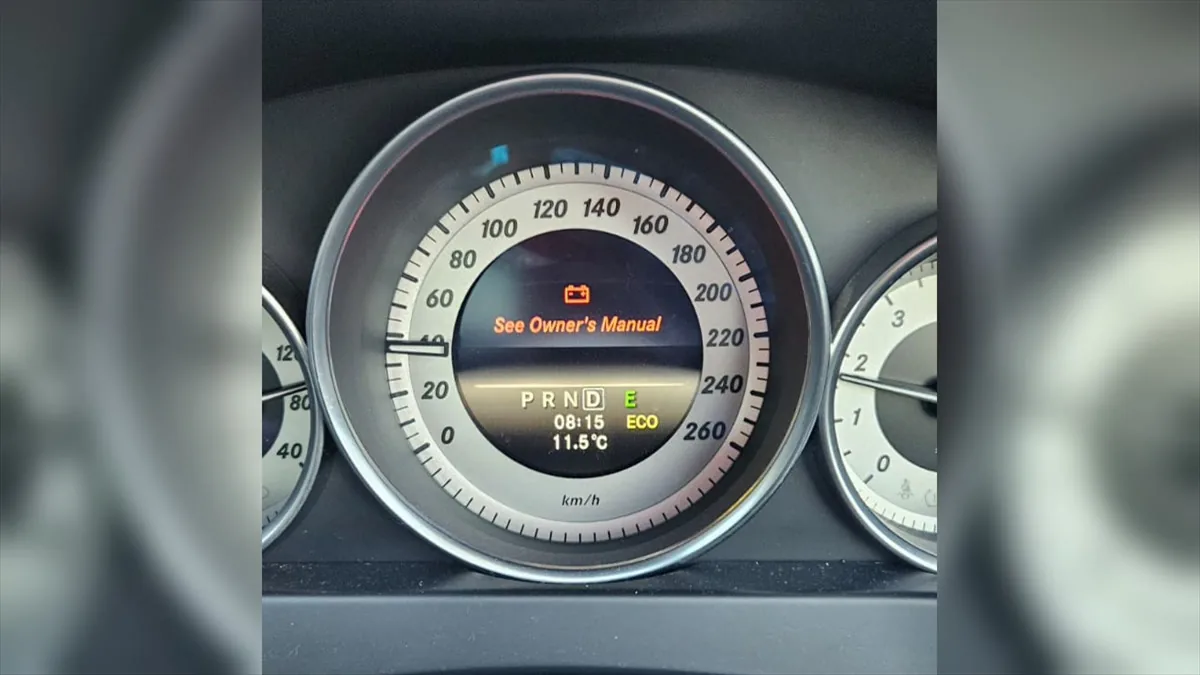
If your dashboard has flashed up “Auxiliary Battery Malfunction,” or the start-stop system has quietly stopped working, you’re not imagining a problem. It’s a real fault, it’s common on modern cars (Mercedes-Benz models especially), and in most cases it’s safe to keep driving carefully for a short while. Here’s what the warning means, what usually causes it, and what to do next.
What you’re noticing
The auxiliary battery is the second, smaller battery that runs your car’s electronics separately from the main starter battery. When it’s failing, drivers usually notice some combination of:
- A dashboard warning light or a direct message: “Auxiliary Battery Malfunction,” “Battery Malfunction” or similar, depending on the model
- The start-stop system switching off on its own, or refusing to restart the engine at traffic lights
- Small electrical glitches: the infotainment screen resetting or rebooting, power windows moving more slowly than usual, or trip computer settings resetting themselves
- The problem coming and going, especially worse in cold mornings or after the car has sat for a few days
If you’re only seeing one or two of these once in a while, it’s easy to write off. It’s the pattern together, especially the warning message plus start-stop dropping out, that points to the auxiliary battery specifically rather than a general electrical gremlin.
Is it safe to drive with an auxiliary battery malfunction?
Generally yes, for a limited time. The auxiliary battery runs comfort and convenience systems, not the engine, so the car will usually still start and drive. But two things make this worth sorting out quickly rather than living with it:
- A weakening auxiliary battery puts more load on the main battery and alternator, which can turn one fault into two
- Losing start-stop and getting infotainment resets while driving is distracting, and on some models a fully dead auxiliary battery can affect safety systems that share the same circuit
Don’t panic, but don’t ignore it for months either. Book a diagnosis while it’s still an inconvenience, not a breakdown.
What is usually causing it
A few things cause this fault, roughly in order of how often we see them:
- The auxiliary battery itself has reached end of life. Like any battery, it degrades with age and short-trip driving that never fully charges it. This is the most common cause.
- A faulty DC-DC converter. Many modern cars use a converter to step voltage down from the main system to the auxiliary circuit. When the converter fails or its connections corrode, the auxiliary battery can’t charge properly even if the battery itself is fine.
- Corroded or loose connections. Battery terminals and earth points corrode over time, especially in coastal areas like Hermanus. A poor connection reads to the car’s computer as a battery fault.
- Coding or fitment issues after a recent battery replacement. On several Mercedes-Benz models, a new battery needs to be registered with the car’s electrical system. Skip that step and the warning can come straight back even though the new battery is fine.
- A parasitic drain from an aftermarket accessory, alarm or tracking device wired into the auxiliary circuit.
What happens if you leave it
Left alone, a failing auxiliary battery tends to get worse, not better. Expect the warning to come back more often, start-stop to stop working altogether, and eventually the main battery to take strain too, which is a much bigger bill than replacing the auxiliary battery on its own. In the worst case you’re looking at a car that won’t start at all, usually at the least convenient time. Sorting it out early is a smaller job and a smaller invoice than waiting for it to take the main battery down with it.
What to do now
- Note exactly when the warning appears: on start-up, only when cold, only after the car has sat, or randomly while driving
- Check whether start-stop has stopped working, and since when
- If you’ve had a battery replaced recently anywhere else, mention that when you book, since it may just need coding
- You don’t need to strip anything down yourself. A scan tool reads the fault codes and tells us within minutes whether it’s the battery, the converter, a connection, or coding
- Auxiliary battery replacement cost depends on the model and whether the converter or connections also need attention, so we’ll confirm the price after the diagnosis rather than guess over the phone
Book a diagnosis before it becomes a no-start. Contact your nearest branch at fangioauto.co.za/contact-us.
What we do at Fangio
Both our branches, Fangio Auto Randburg and Fangio Auto Hermanus, diagnose auxiliary battery and charging faults. We connect a scan tool to read the fault codes, test the auxiliary battery and the DC-DC converter under load, and check the terminals and earth points for corrosion. On most cars this takes well under an hour to identify the actual cause.
From there:
– If it’s the battery, we replace it and, where the model requires it, code the new battery to the car’s electrical system so the warning doesn’t return
– If it’s a converter or wiring fault, we explain what’s failed and quote for the fix before doing any work
– Hermanus fits batteries directly, including auxiliary batteries. Randburg fits batteries as part of a scheduled service rather than as a standalone walk-in job, so if you need a walk-in battery fit, Hermanus is the quicker route
– For broader electrical faults beyond the battery itself, see our auto electrical page for what that work covers
Mercedes-Benz auxiliary battery malfunction (C-Class, ML350, GLK350)
This warning shows up often on Mercedes-Benz models, including the C-Class, ML350 and GLK350, partly because these cars rely on the auxiliary battery for more onboard electronics than most. If you own one of these and you’re seeing the exact message “Auxiliary Battery Malfunction,” the cause list above still applies, but coding after a replacement is more often the missing step on these models specifically. Tell us the exact model and message wording when you book so we can check for known issues on that platform.
If your fault turns out to be the main battery or charging system rather than the auxiliary one, our battery replacement page covers that separately.
Questions people ask
What does “auxiliary battery malfunction” actually mean?
It means the car’s second, smaller battery, the one that runs electronics rather than the engine, isn’t charging or holding charge correctly. It’s not the same as your main starter battery failing, though the two can affect each other over time.
Can a bad auxiliary battery cause other problems?
Yes. It commonly disables start-stop, causes infotainment resets, and can put extra strain on the main battery and alternator if left unresolved.
Is it the same as a normal flat battery?
No. A flat main battery usually means the car won’t start at all. An auxiliary battery fault usually leaves the engine starting fine, with the symptoms showing up in comfort and convenience systems instead.
How much does it cost to replace an auxiliary battery?
It depends on the vehicle and whether anything beyond the battery needs attention. We confirm pricing after a quick diagnosis rather than quoting blind.
Should I disconnect the battery myself to reset the warning?
Don’t. On several models this can trigger other faults or require recoding that’s better left to a proper diagnosis.
What are the symptoms of a bad auxiliary battery?
The main signs are a dashboard warning message (worded differently depending on the model), the start-stop system switching off or refusing to restart at traffic lights, small electrical glitches such as the infotainment screen resetting, and the problem coming and going, especially on cold mornings or after the car has sat for a few days. Seeing more than one of these together, rather than just one on its own, is what points at the auxiliary battery specifically.
Book a check today
Don’t wait for a no-start. Get the fault confirmed properly and fixed once.
- Fangio Auto Randburg: 110 Susman Ave, Blairgowrie, Randburg. Monday to Friday, 07:30–16:30.
- Fangio Auto Hermanus: 13A Steenbras Road, Hermanus Industrial. Monday to Friday, 08:00–17:00. RMI approved, with a 12-month/10,000km warranty on workshop repairs.
Contact details and directions for both branches: fangioauto.co.za/contact-us
Already have a quote?
Get an honest second opinion
Send it over and we’ll review it, explain it plainly, and beat it where we can.