What to do the moment you see coolant
If the temperature gauge is climbing, a coolant warning light is on, or you can see steam, pull over somewhere safe and switch the engine off. An overheating engine takes damage quickly, and the gap between a hose repair and a much larger bill is often just how far the car was driven after the first warning.
Do not open the radiator cap or the expansion tank while the engine is hot. The system holds pressure at temperature, and lifting a cap releases scalding coolant and steam. Wait until it is cold. Coolant is usually brightly coloured with a sweet smell, but the colour varies by type and by whatever has been topped up before, so treat it as a hint rather than proof, and do not touch or taste it. It also runs along panels before it drips, so the wet patch is not always under the part that failed.
Topping up moves the car, it does not repair it. Do not drive if the temperature rises, a warning light is on, steam appears, the level drops again after a top up, the heater suddenly blows cold, or you do not know how fast the coolant is going. Arrange recovery when you are not sure.
Signs you are losing coolant
Not every leak leaves a puddle. These are the signs worth acting on.
- A coloured, slightly oily-feeling patch on the ground after the car has been parked.
- The expansion tank needing regular topping up with no obvious drip.
- A sweet smell around the engine bay after a run, or inside the cabin.
- A gauge sitting higher than normal, or climbing in traffic and settling again on the open road.
- Crusty coloured staining on hoses, clamps, the radiator or the block, which is dried coolant marking an old seep.
A slow seep can behave for weeks, then fail properly on the worst possible day.
Is it the radiator, or something near it
Radiator leak is how most people describe it, but it is only one of the parts that can be losing coolant.
- Rubber hoses, which harden, crack and split with age and heat, most often near the ends.
- Hose clamps and connections that have relaxed or corroded.
- The pressure cap, once it no longer holds its rated pressure.
- The plastic end tanks and the seam where they meet the radiator core.
- The radiator core itself, from stone damage, corrosion or a knock.
- The expansion tank, which can crack or split at a seam.
- The thermostat housing and its gasket.
- The water pump, which often weeps as its seal gives up.
- The heater core, which shows as a damp footwell, misted windows and a sweet smell inside rather than a puddle outside.
When nothing outside the engine is wet
Coolant that keeps disappearing with nothing visibly leaking is a different problem. Persistent loss with no external source, white exhaust vapour after the engine is warm, oil that looks contaminated, or a system that keeps pressurising can all point at a leak inside the engine. Those are not signs to work through on a driveway. Stop driving and book a diagnosis.
How the leak source is actually found
Order matters, because replacing a radiator that was never leaking is an expensive way to learn nothing.
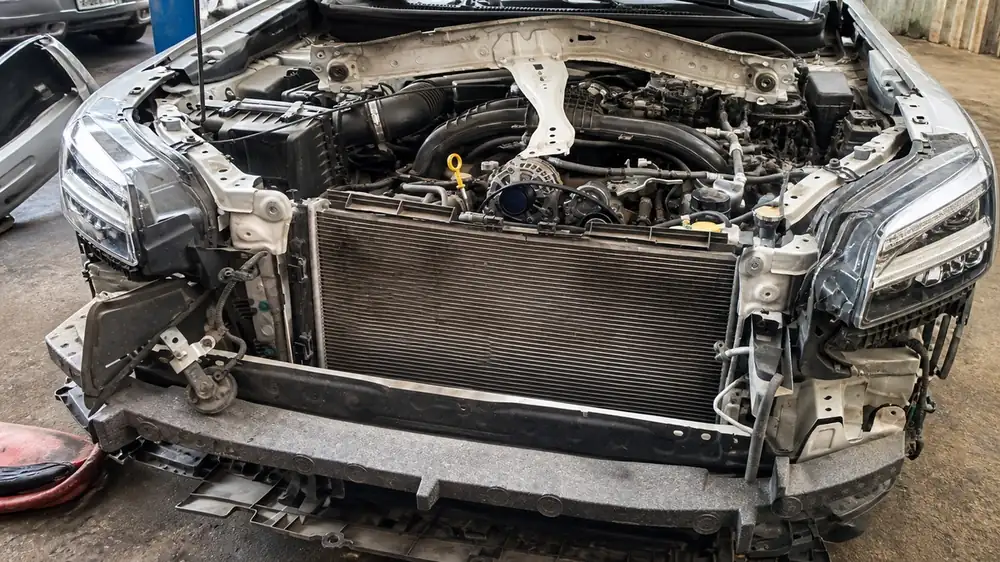
- A cold visual inspection of hoses, clamps, the radiator and its seams, the cap and its sealing face, the water pump and the block, looking for wet patches and dried staining.
- A cooling system pressure test, taken to the pressure specified for the vehicle or the cap and no higher, because over-pressurising can damage hoses, the radiator or the heater core. Pressure brings out a leak that normally only shows once the car is hot.
- A cap test, because a cap that cannot hold its rated pressure produces symptoms that look like a leak.
- A look at the coolant. Level, condition, the type in the system and whether products that do not belong together have been mixed in.
- Further diagnosis if nothing external appears, because coolant disappearing with no visible leak has to be answered before the car goes back on the road.
This is ordinary workshop car diagnostics rather than guesswork. The point is to name the failed part before anybody quotes for it.
Stop-leak in a bottle, and what a flush will not do
Sealant is an emergency measure, not a repair, and not a safe reason to keep driving. It sets where coolant escapes, but it can settle just as easily in the narrow passages of the radiator core, the heater core and the thermostat area. Restricted flow there causes the overheating you were trying to avoid, and not every product suits every coolant. If a bottle has gone in, say so when you book.
A flush gets confused with this job too. It deals with coolant condition and deposits, and our guide to the signs a car needs one covers that. It does not repair a leak.
Repair or replace
Once the source is known the choice gets easier. Hoses, clamps, caps and gaskets are wear parts, and they are normally replaced rather than repaired.
Radiators depend on the radiator. Whether one can be repaired comes down to the material, where the damage sits, how corroded the rest of the unit is and what can be warranted afterwards. That is an assessment for a radiator specialist with the unit in front of them, not a rule you can apply from a photo. Plastic end tanks, seam failures, heavy corrosion and radiators already through an overheat are the cases most often replaced.
What decides the cost
There is no single price for a coolant leak, and a workshop quoting one before seeing the car is guessing. What moves the number is which part failed, how much has to come off to reach it, and parts availability for your make, model and year. A leak that also cooked the engine is a different job again. Diagnosis first, then a quote built on the confirmed source.
Do not skip the overheating question
If the car ran hot before the leak was found, there are two questions, not one. Where is the coolant escaping, and did the overheating damage anything else. Heat does damage well away from the wet patch, so a car driven hot deserves a proper check before anyone calls it fixed.
Book a cooling system check at Fangio Auto Randburg
You want two things: the leak stopped, and a straight answer on whether the car is safe to drive. Fangio Auto Randburg has been servicing and repairing cars in Blairgowrie since 2009, and cooling system work sits inside our everyday car repairs and services.
Tell us the make, model and year, what you are seeing, whether the temperature has gone up and whether anything has been added to the system. We start with a pressure check and quote once we know what is leaking. If the car is overheating or steaming, do not drive it in.
- Phone 011 326 3133
- WhatsApp 082 402 3517
- 110 Susman Ave, Blairgowrie, Randburg
- Monday to Friday, 07:30 to 16:30. Closed Saturday, Sunday and public holidays.
You can also contact us with the details and a photo if you are not sure what you are looking at.
Frequently asked questions
How do I fix a radiator leak near me? Start with a cooling system pressure check rather than a part. The leak has to be traced to a specific hose, clamp, cap, tank, gasket or the radiator before anyone can say what the repair involves or what it costs.
Can I drive with a coolant leak? Treat it as no until someone has looked at it. Do not drive if the gauge rises, a warning light is on, steam appears, the level drops again after a top up, the heater goes cold, or you do not know how fast the coolant is going. Arrange recovery if you are not certain.
Is it the radiator or just a hose? You cannot tell from the puddle, because coolant runs and drips well away from where it escaped. A cold inspection and a pressure test show which part is leaking, and hoses, clamps and the cap get checked first.
Will a stop-leak product cause problems? It can. The material that seals the leak can also settle in the radiator core, the heater core and the thermostat area, restricting flow and causing overheating. Treat it as an emergency measure only and tell the workshop it has been used.
When can a radiator be repaired instead of replaced? It depends on the unit. A radiator specialist has to assess the material, where the damage is, the condition of the rest of the core and what can be warranted. Plastic end tanks, seam failures, corroded cores and radiators that have already overheated are the ones most often replaced.
Why did the leak start right after the car overheated? Heat and pressure find the weakest point. A hose, seam or cap that was coping quietly can let go once the system runs hotter than it should. That is why the overheating needs explaining, not only the wet patch it left behind.
What does a car leak test involve? A proper leak test starts cold, with a visual check of the hoses, clamps, radiator, cap and water pump, then a cooling system pressure test that brings out a leak that normally only shows once the system is under pressure. That is how the source gets traced before anyone quotes for a repair.
Already have a quote?
Get an honest second opinion
Send it over and we’ll review it, explain it plainly, and beat it where we can.