Feel a shake or judder through the seat and the steering wheel while your car is just sitting there: at a light, in traffic, or parked in the driveway with the engine running? This is a common complaint, and it almost always comes down to one of two causes. One is a wear item that gets worse slowly. The other can be urgent. The quickest way to tell them apart is a simple test you can do yourself, and it’s below.
What you are noticing
Most drivers describe this problem in the same order:
- A shake or vibration that you feel through the seat, floor or steering wheel when the engine is idling: stopped at a light, waiting in the driveway, or sitting in traffic.
- The vibration changes, or disappears, once you shift into neutral or park.
- Or, the vibration stays rough no matter what gear you’re in, and doesn’t smooth out as the revs come up.
- Sometimes a warning light on the dashboard comes on at the same time.
- In some cases a faint smell, a rougher-than-normal engine note, or slightly worse fuel use goes along with it.
Which of these you notice tells you a lot before you even open the bonnet.
The one test that tells you which it is
Put the car in neutral, or park for an automatic, with the handbrake on, and pay attention to the vibration.
- Vibration settles down or goes away in neutral, but comes back in gear: this points to a worn or failing engine mount. Mounts hold the engine and gearbox steady in the bay. When one wears out, the engine can rock or shift slightly under load, which you feel as a shake that’s worse in gear than in neutral.
- Vibration stays rough and uneven no matter what gear you’re in, especially if it comes with a flashing or steady check engine light. This points to a misfire. One or more cylinders aren’t firing properly, so the engine runs unevenly at all times, not just under load.
This isn’t a perfect diagnosis on its own (a workshop still needs to confirm it) but it’s the fastest way to know which direction you’re dealing with before you book a check.
What is usually causing it
Worn engine mounts
– Rubber mounts perish and crack with age and heat, the same way any rubber part does over years of use.
– A mount can also fail suddenly after a hard knock, hitting a deep pothole or a kerb.
– Fluid-filled mounts can develop a slow leak, losing the damping that keeps the engine steady.
Misfires
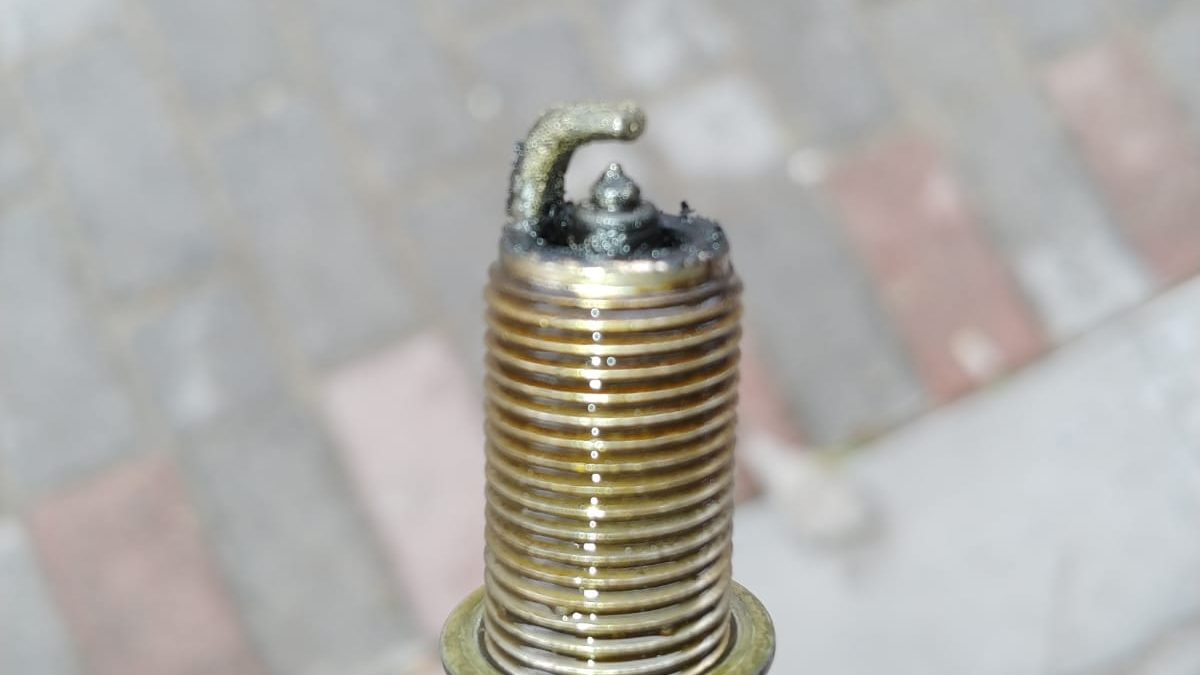
– Worn or fouled spark plugs are one of the most common causes. See our detailed look at spark plugs fouled with oil if you’ve also noticed white or blue smoke, or a burning oil smell.
– A failing ignition coil, which delivers the spark to the plug.
– A vacuum leak, letting unmetered air into the engine.
– A fuel delivery problem, such as a clogged injector.
Both causes are common. Neither is rare or unusual, so there’s no need to panic, but they do need different fixes.
What happens if you leave it
A worn engine mount left unfixed doesn’t usually strand you overnight, but it doesn’t fix itself either. Over time, a failing mount lets the engine and gearbox move more than they should. That extra movement puts strain on the exhaust system, cooling hoses, wiring looms and drivetrain components that weren’t designed to flex that much. In the worst case, a mount can fail completely, letting the engine drop or shift enough to damage surrounding parts, turning a moderate repair into a much bigger bill.
A misfire left unfixed tends to get worse faster. Unburned fuel from a misfiring cylinder can pass through to the catalytic converter, and catalytic converter damage is one of the most expensive repairs on a modern car, far more than the plug, coil or vacuum fix that likely caused it. A misfire also wastes fuel, since the engine is working less efficiently than it should, and it can develop into rougher running, hesitation, or reduced power over time.
What to do now
- You don’t need to pull over immediately for either cause on its own, but if the check engine light is flashing (not just on steady), stop driving and have the car looked at as soon as you reasonably can. A flashing light usually means an active misfire that can damage the catalytic converter quickly.
- Do the neutral test above and note what you find.
- Note anything else that changed at the same time: a warning light, a smell, a new noise, or worse fuel economy.
- Avoid hard acceleration or high revs until it’s checked, since both a loose mount and a misfire are made worse by load.
- Book a diagnostic check rather than guessing at parts. Reading the fault codes properly is the difference between fixing the actual cause and paying to replace something that was fine.
Not sure which it is, or want it confirmed properly? Book a diagnostic check and get the fault codes read before anything is quoted.
What we do at Fangio
We start with a proper diagnostic check rather than a guess. That means reading the engine’s fault codes, checking for stored misfire codes against specific cylinders, and inspecting the mounts visually and under load (a technician can often see or feel a worn mount shift when the engine is gently revved with the bonnet open). This tells us which of the two, or occasionally both, is actually happening, before any parts are ordered or any price is given.
From there:
– A worn mount is replaced with a correctly rated new one for your engine and gearbox combination.
– A misfire is traced to its source (plugs, coils, vacuum or fuel) and only the part that’s actually faulty is replaced.
Most diagnostic checks and straightforward mount or plug/coil replacements are same-day jobs, though this depends on parts availability for your specific vehicle. While the engine bay is open, we also check the surrounding hoses, wiring and drivetrain mounts that a failing mount can put strain on, so nothing related gets missed.
Questions people ask
Is it safe to drive with the car vibrating at idle?
Short trips are usually fine while you get it checked, especially if the vibration settles in neutral. A flashing check engine light is the exception. Stop and get it looked at soon, since that usually means an active misfire that can damage the catalytic converter.
Why does my car vibrate at idle but smooth out once I’m driving?
This pattern often points to a mount or idle-quality issue that’s more noticeable at low revs, since the engine has less momentum to smooth out small imbalances when idling than it does at speed.
Why does my car vibrate in drive but not in neutral?
This is the classic engine mount pattern. In gear, the engine and gearbox are under a small amount of load even at a standstill, which is enough to expose a mount that’s lost its grip.
What does a misfire actually feel like?
An uneven, stumbling shake that doesn’t settle down in any gear, sometimes with a slight jerk or hesitation, and often, though not always, a check engine light.
Can a worn engine mount cause a check engine light?
Not directly. A check engine light points to a misfire, sensor fault or similar electronic issue, not a mechanical mount. If you have both a mount-pattern vibration and a warning light, treat it as two separate things worth checking.
How much does it cost to fix?
It depends on which cause it turns out to be and which parts are affected. We can only give an accurate price once the diagnostic check confirms the cause.
Ready to get it checked?
Both engine mount replacement and misfire diagnostics are handled at our Randburg and Hermanus workshops. Find your nearest branch and book a check. We’ll read the fault codes and confirm which one it is before anything gets quoted.
Already have a quote?
Get an honest second opinion
Send it over and we’ll review it, explain it plainly, and beat it where we can.