If your car shakes at idle but settles once you’re moving, or you feel a clunk when you shift into gear or pull away hard, a worn engine mount is one of the most common causes. It’s a well-known fault and, in most cases, safe to drive short distances while you get it checked, but not indefinitely. Below is what to look for, what’s usually behind it, and what to do next.
What you are noticing
Engine mount problems tend to show up gradually, then get harder to ignore. Drivers usually describe one or more of these:
- A vibration or shudder through the seat, steering wheel or gear lever at idle, that smooths out once you’re driving normally.
- A clunk, thud or lurch when you shift from park into drive or reverse, or when you take off from a standstill.
- A knocking or banging noise from the engine bay over speed bumps, potholes or rough tar.
- The engine visibly rocking or lifting when you blip the throttle with the bonnet open.
- A delayed jerk when you accelerate hard or lift off the accelerator suddenly.
- Extra engine noise or rattle inside the cabin that wasn’t there before.
Any one of these on its own can point to something else: a worn drive belt, a loose exhaust bracket, a wheel bearing. Together, or repeated every time you shift or accelerate, they point more strongly at the mounts.
What is usually causing it
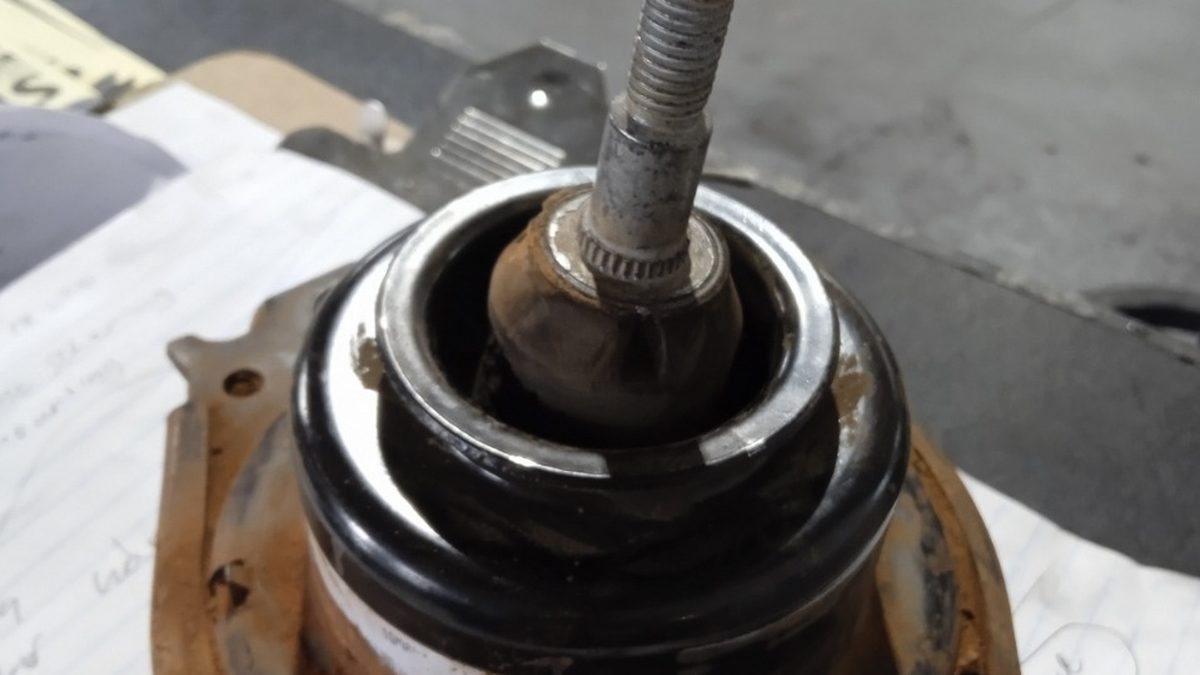
An engine mount is a bracket that holds the engine (and often the gearbox) to the chassis, with a block of rubber or a hydraulic (fluid-filled) cushion inside it to absorb vibration and movement. Most cars have three or four of them. Over time, and especially with engine oil or coolant leaks nearby, that rubber or fluid breaks down.
Common causes, most frequent first:
- Perished rubber. Heat, oil contamination and age dry out and crack the rubber, so it no longer damps vibration the way it should.
- A torn or split mount. The rubber separates from the metal casing, or splits right through, and the engine is left with almost nothing to control its movement.
- A failed hydraulic mount. On mounts with a fluid-filled chamber, the fluid leaks out or the internal diaphragm fails, and the cushioning effect disappears.
- A mount that has come loose. Less common, but the mounting bolts can work loose over time, which produces a similar clunk without the mount itself being worn.
A worn mount lets the engine move more than it’s designed to. That movement is what you feel as vibration at idle and hear as a clunk under load: the engine physically shifting until something (a bracket, a hose, another mount) stops it.
What happens if you leave it
A car will often keep running with a worn mount for weeks or months, which is why it’s easy to put off. The risk builds quietly:
- More parts wear faster. A mount that isn’t controlling engine movement puts extra strain on the remaining mounts, the driveshafts, exhaust brackets, wiring looms and drive belts running nearby. What started as a one-mount job can become two or three, plus whatever it damaged on the way.
- The clunk gets worse. As the rubber or fluid degrades further, the movement, and the noise, increases. A mild shudder can become a hard jolt on every gear change.
- A mount can fail completely. If a mount tears through or a bolt shears, the engine can drop or shift sharply on its remaining mounts. This can damage the radiator, fan, drive belts or wiring, and in some cases leave you stranded.
- It gets more expensive the longer it waits. Replacing one mount before it fails is a contained job. Replacing a mount after it has damaged a belt, a hose or a neighbouring bracket costs more and takes longer.
Driving a short distance carefully to a workshop is generally fine. Driving on it for months, hoping it settles, is how a small repair turns into a bigger one.
What to do now
- You don’t need to stop immediately if the symptom is a vibration at idle or a clunk on gearshift, and nothing else feels wrong.
- Pull over and stop if you hear a loud bang, feel a sudden drop or lurch from the engine, smell burning, or the engine noise changes sharply and suddenly.
- Note when it happens: at idle, on gearshift, under acceleration, over bumps. This helps a mechanic find the right mount faster.
- Book a diagnostic inspection rather than guessing from the sound alone. A mount that looks fine from above can still be split underneath, and a vibration can also come from an engine misfire, a worn drive belt or a wheel issue that has nothing to do with the mounts. A mechanic checks all of it, not just the part you suspect.
- Avoid heavy loads or hard acceleration until it’s been looked at, since both put more strain on a weakened mount.
Book a check with Fangio Auto Service before it gets worse. Get in touch with your nearest branch to arrange a time.
What we do at Fangio
Both the Randburg and Hermanus branches diagnose the fault before any work is booked. A mechanic checks each mount under load (with the engine running and the parking brake on, or with the car up on a hoist) for tears, softening, oil contamination and movement that shouldn’t be there. Where the vibration could be something else, that gets ruled in or out at the same time, rather than replacing a mount on a guess.
If a mount needs replacing, it’s usually a same-day job once parts are confirmed, and it’s common to replace more than one at a time if a neighbouring mount is close to the same age and condition. All labour carries Fangio’s 12-month or 10,000 km warranty from the invoice date, whichever comes first. See the full range of engine work on the services and repairs page.
Questions people ask
How many engine mounts does my car have?
Most cars have three or four: usually one on each side of the engine, one at the front or back (sometimes called a torque mount or dogbone mount), and a mount for the gearbox. The exact number and layout depends on the make and model.
Is it safe to drive with a broken engine mount?
For a short distance, driven gently, usually yes. For daily driving over weeks, no: the extra strain on nearby parts and the risk of a sudden failure make it worth getting checked promptly rather than waiting.
How do I know if it’s the engine mount and not something else?
A vibration that’s worse at idle and smooths out at speed, or a clunk specifically on gearshift or hard acceleration, both point at the mounts. A vibration that gets worse the faster you drive is more often a wheel, tyre or driveshaft issue. A diagnostic check will tell you which.
What does a clunking sound when changing gear usually mean?
It’s one of the clearest engine mount signs. A worn mount lets the engine and gearbox shift as the drivetrain takes up load on a gear change, and that movement is felt and heard as a clunk.
Can a bad engine mount cause other damage?
Yes. Left long enough, the extra movement can wear through a nearby hose, damage a bracket, strain a drive belt, or in a worst case let the engine drop onto other components.
Does this apply to both petrol and diesel cars?
Yes. The symptoms and causes are the same regardless of engine type. Diesel engines vibrate more at idle by nature, which can make a worn mount’s shudder more noticeable sooner.
Book a check
If your car is vibrating at idle, clunking on gearshift, or you’ve felt the engine shift under acceleration, get it looked at before it becomes a bigger repair. Fangio Auto Service has two branches:
- Fangio Auto Randburg: 110 Susman Ave, Blairgowrie, Randburg. Open Monday to Friday, 07:30–16:30.
- Fangio Auto Hermanus: 13A Steenbras Road, Hermanus Industrial. Open Monday to Friday, 08:00–17:00.
Visit the contact page to reach your nearest branch and book a diagnostic check.
Already have a quote?
Get an honest second opinion
Send it over and we’ll review it, explain it plainly, and beat it where we can.