Quick answer
If you are looking for a timing belt for a Toyota Corolla, the first thing to settle is whether your Corolla uses a belt at all.
The Corolla has been sold in South Africa across many generations and several engine families. Some of those engines drive the camshafts with a rubber timing belt, which most South African workshops call a cambelt. Others use a metal timing chain running in oil.
There is no single correct answer for "the Corolla". It depends on the exact engine in your car, not just the model year. Before you buy a kit or agree to a price, confirm what your engine actually uses.
Why Corolla timing systems differ
Different Corolla generations were sold with different engine families, and a single generation often had several capacities. Manufacturers also moved between belt and chain designs over time.
Two things follow. A workshop or supplier cannot quote on "a Corolla" alone, because they need the engine. And forum advice about someone else's Corolla may be about a completely different engine, even if the badge looks the same.
This matters here, because South African roads carry a wide spread of Corolla ages plus imported cars that were never part of the local range. The model year on the licence disc is a starting point, not the full story.
How to identify the exact setup on your car
Work through these in order. Each gets you closer to a definite answer.
1. Your owner manual and service book. The maintenance schedule that came with the car is written for your model and engine. If it lists a timing belt replacement at a set interval, you have a belt. If there is no timing belt item at all, that points towards a chain, but still confirm it.
2. The engine code. A Toyota engine code is the most useful single piece of information a workshop can have. Your registration papers normally list an engine number rather than a separate Toyota engine code. The code itself may appear on an identification label or as a stamping on the engine, and it can also be confirmed through a vehicle-specific lookup. With it, a workshop can check the correct timing arrangement and the correct parts.
3. The VIN. A modern VIN is normally seventeen characters and appears on your licence disc, on the registration papers and usually on a plate at the base of the windscreen or door aperture. A VIN-specific lookup ties the car to the exact build, which is the safest way to avoid ordering the wrong kit. Older or imported Corollas may not carry a standard seventeen character VIN. If yours does not, give the workshop the chassis or frame identifier, the engine number and all the vehicle papers you have.
4. A physical inspection. A technician can look at the front of the engine for clues about how the camshafts are driven. How much is visible, and how certain the answer is, varies by engine, and cover layout alone does not always prove belt or chain. The reliable approach is for the workshop to combine your identifiers, catalogue data and what they can see. Do not remove a timing cover yourself to check.
If you are ordering parts yourself, do not skip steps 2 and 3. A kit ordered on year and capacity alone is a common wrong-part return.
For the general difference between the two designs, see our guide on timing belt versus timing chain.
When replacement may be due
We are not publishing one interval for every Corolla, because there is not one. Belt intervals are set per engine, usually as a distance or a time limit, whichever comes first, and differ between engine families and markets.
Instead:
- Read the interval from your own service schedule or a VIN-specific lookup, not from a general article.
- Treat the time limit as seriously as the kilometre limit. Rubber ages, so a low-mileage Corolla that has stood for years can be due on age alone.
- If there is no record that the belt was ever changed, assume it has not been done and have it inspected early.
Chains are different. A chain generally lasts much longer than a belt and is not usually on a fixed replacement schedule, but it is not maintenance free. Guides and tensioners wear, and delayed oil changes shorten their life.
Warning signs worth acting on
Some belts fail with little or no warning, which is why the schedule matters more than symptom spotting. The symptoms below are worth acting on, but none of them prove timing wear on their own. Each has other possible causes and needs proper diagnosis by a workshop.
- A rattle or whirring noise from the front or top of the engine, especially on a cold start.
- A rough idle or misfire without an obvious cause.
- The check engine light with camshaft or crankshaft position related codes.
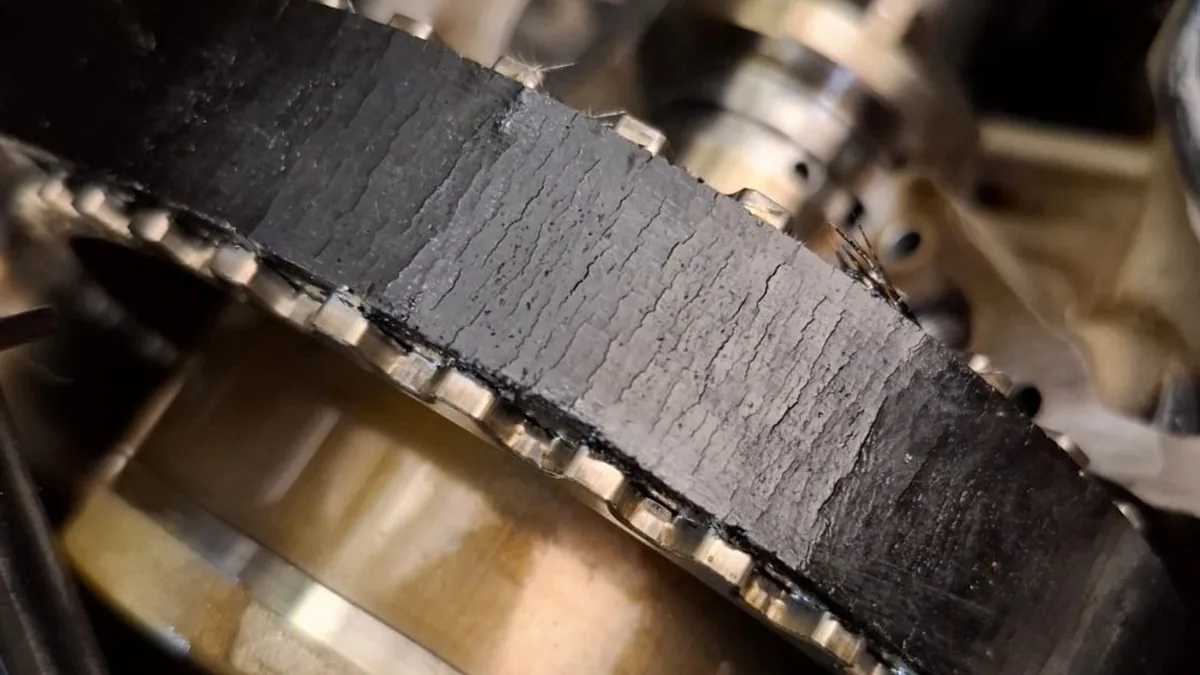
- Visible cracking, glazing, missing teeth or oil contamination on a belt when the cover is off.
- Any oil leak near the timing cover, since oil attacks a rubber belt.
- Hard starting or a loss of power that came on gradually.
If a belt lets go on an engine where the valves and pistons share space, the damage is normally far more expensive than the belt job. A new noise from the timing end of the engine is worth checking straight away.
What a proper replacement quote should include
When you ask for a price on a timing belt for Toyota Corolla work, a one-line number tells you very little. A good quote identifies the vehicle and spells out the scope. Ask for this in writing:
- The exact engine identified, not just "Corolla".
- Whether the job is a belt or a chain, and why.
- Labour hours quoted for that specific engine.
- Which parts are included: belt, tensioner, idler pulleys and any guides.
- Whether the water pump is included or excluded, and the reason.
- Whether cam and crank seals are included, or quoted separately if found leaking.
- What happens to the price if something is found once the covers are off.
- The warranty on parts and labour.
Why the water pump, tensioner and pulley scope matters
On some belt-driven engines the water pump sits behind the timing cover and is driven by the same belt. Getting to it later means repeating most of the same strip-down, so replacing a pump that is already exposed usually costs far less than a second visit. Ask whether yours is behind the cover.
The same logic applies to tensioners and idler pulleys. A worn bearing can destroy a new belt, so fitting a new belt onto old pulleys is how a job gets done twice. A full-kit quote is often cheaper once you count the second visit.
We deliberately do not publish a fixed rand figure. The correct price depends on the engine, the parts you choose and what is found during the strip-down. Any number quoted without your engine details is a guess.
Get your Corolla checked at Fangio Auto Randburg
Send us three things and we can give you a straight answer instead of a guess:
- The year of your Corolla
- The engine size, for example 1.3, 1.6 or 1.8
- The VIN, the seventeen character number on your licence disc
With those, our team can confirm whether your engine uses a belt or a chain, look up the correct schedule and quote the right scope with the right parts.
Fangio Auto Service Randburg
110 Susman Ave, Blairgowrie, Randburg
Phone: 011 326 3133
WhatsApp: 082 402 3517
Trading hours: Monday to Friday, 07:30 to 16:30
You can also contact us here, see the Randburg branch page, browse our services and repairs, or read more about the work we do on Toyota vehicles.
FAQ
Does every Toyota Corolla have a timing belt?
No. Toyota has used both timing belts and timing chains in Corolla engines over the years. Which one you have depends on the engine in your car, so it needs confirming against your engine code or VIN.
How do I find out which one my Corolla has?
Start with the maintenance schedule in your service book, then have the engine identified from the engine number, engine code or a VIN-specific lookup. A workshop should combine those identifiers with catalogue data rather than relying on a quick look alone.
Is a timing chain maintenance free?
No. A chain lasts much longer than a belt and is not on a fixed schedule, but chains, guides and tensioners still wear, and skipping oil services shortens their life. If a chain is noisy, stretched or triggering a fault code, see our guide to timing chain service symptoms.
Should the water pump be replaced at the same time?
On some belt-driven engines the water pump sits behind the timing cover and is driven by the belt, so doing both together avoids paying for the same strip-down twice. Ask your workshop whether that applies to your engine.
Can I drive if the timing area is making a noise?
It is not worth the risk. A noise there has several possible causes, and a timing failure can cause serious internal engine damage. Have it diagnosed before driving further.
Already have a quote?
Get an honest second opinion
Send it over and we’ll review it, explain it plainly, and beat it where we can.