Wipers tend to fail at the worst possible moment, which around here usually means somewhere between a clear sky and a wall of rain coming off the sea. If your car windscreen wipers are not working, the useful thing to know is that dead wipers are not one fault. They’re a short list of faults, and the way yours stopped tells you a lot about which one you’re dealing with.
This guide covers what actually stops windscreen wipers working, what you can check safely yourself, and where the line sits between a five-minute job and something that needs a workshop with test equipment.
Start with the safety part
South Africa’s National Road Traffic Regulations cover this, and regulation 203 is the one that deals with wipers. Put simply, a car on a public road needs at least one wiper that isn’t worked by hand and that keeps the driver’s part of the windscreen properly clear. That’s a plain summary rather than the legal wording, but the practical point is straightforward. A car with dead wipers isn’t only inconvenient. On a public road it no longer meets the requirement.
In practice that means two things. If it’s raining and the wipers have stopped, pull off somewhere safe instead of pushing on. If it’s dry, get the car looked at now rather than discovering the problem again in the next storm.
And before anyone starts poking around under the cowl at the base of the windscreen, switch the wipers off, turn the ignition off and take the key out. Wiper motors are strong, and an arm that comes to life while your fingers are in the linkage will hurt you.
What your symptom is pointing at
| What you notice | Where a workshop would look first |
|---|---|
| Nothing at all. No movement, no sound, on any setting | Power getting to the circuit, including the fuse, and whether the motor is being asked to run |
| You hear a hum, click or buzz but nothing moves | The mechanical side. The linkage, the pivots, and whether the arms are seized or the drive has come loose from the motor |
| One wiper sweeps, the other one stays put | The arm and its spindle. On a shared linkage this is mechanical far more often than electrical |
| They only work on one speed, often the fast one | The command side. The stalk switch, the relay or module that drives the slow speed, and the wiring and earths feeding it |
| Intermittent or delay mode has stopped, everything else works | Whatever times the pause on that vehicle, which may be inside the switch, a separate relay or a body control module |
| They stop mid-screen instead of parking at the bottom | The park circuit and its switch inside the motor assembly, plus the earth and wiring that circuit depends on |
| Slow, laboured, or juddering across the glass | Mechanical drag in the linkage and spindles, a tired motor, poor supply or a weak earth, and blade or screen condition |
| You fitted a new fuse and it blew again | Why the circuit is drawing too much current. That is a fault to find, not a fuse to keep replacing |
Treat those as starting clues, not diagnoses. Wiper systems differ a lot between makes, models and years, and your owner’s handbook is the authority on your own car.
Not sure which side of that table your car sits on? That is exactly what a test is for. Book it in with Fangio Auto Hermanus and the cause gets identified before anything is ordered, which usually costs less than replacing a motor that turned out to be fine.
Blades or the mechanism behind them
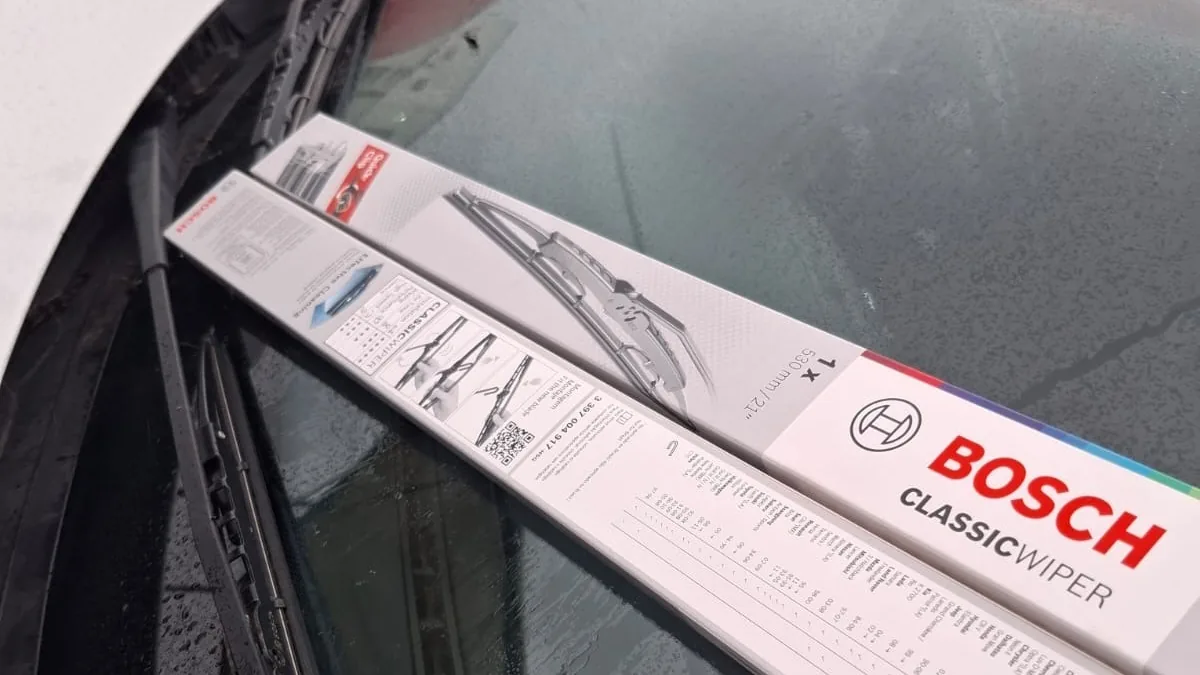
Worth separating early, because the two get confused. A worn blade smears, streaks, chatters or leaves an arc of water behind it, but the arm still sweeps normally. That’s a blade problem, and it’s the cheap end of the story.
Wipers that don’t move, move on the wrong settings, or stop in the wrong place are a different animal. New blades will do nothing for any of that. If the arms aren’t sweeping the way they should, the fault sits in the electrical circuit or in the mechanism, and fitting rubber won’t touch it.
So a new set of blades is the right answer to smearing and streaking, and the wrong answer to a wiper that has stopped moving. Knowing which of those you’ve got is the whole point of the checks below.
Fuses and the power supply
A blown fuse is a common reason for wipers dying all at once, with no noise and no movement. Your handbook shows the fuse box positions and the fuse for your model. Nobody can tell you a fuse number over the phone, because layouts change between models and even between model years, so ignore any article that gives you one.
Here’s the part that matters more than the fuse itself. A fuse blows because something asked the circuit for more current than it was designed to carry. Sometimes that’s a one-off. Often it isn’t. If a replacement fuse blows again, whether that’s immediately or a week later, the fuse was the symptom and the real fault is still sitting there. Fitting a bigger fuse to stop it happening is how wiring gets cooked, so don’t.
Supply problems also come from the boring end of the circuit. Corroded connectors, a broken wire in the loom, or a poor earth can all starve the motor while every fuse in the car is perfectly fine.
The command side: switch, relay or control module
Something has to tell the motor to run, and at what speed. On older vehicles that’s mostly the stalk switch and a relay. On newer ones a body control module often sits in the middle, taking the request from the switch and deciding what actually happens.
This is why the “only works on fast” complaint is so useful. If high speed runs, the motor and its earth are clearly alive. What’s failed is whatever completes the slow speed or intermittent path, and that’s the switch, the relay, the module or the wiring between them.
Which of those it is has to be tested. Relay layouts and module functions vary by vehicle, and swapping parts to see what sticks is an expensive way to guess.
Wiring and earths
The loom takes a hard life. Wiper wiring runs through the cowl area at the base of the windscreen, where water collects, and some of it flexes every time a door opens or a bonnet closes. Chafed insulation, green corroded pins and a loose earth strap are all normal findings on older cars.
A weak earth is worth calling out on its own, because it doesn’t fail cleanly. It slows the wipers down, makes them behave oddly on some settings, or lets them work in the dry and struggle under load. It’s the sort of fault people replace a motor for.
The motor and the park circuit
Wiper motors do fail. Brushes wear, windings give up, and the gearbox inside the motor assembly can strip. What matters is that a motor is only condemned after the supply, the earth and the command signal reaching it have been tested. A motor that isn’t being told to run looks exactly like a motor that’s dead.
The park circuit deserves its own mention. That’s the arrangement, usually a switch inside the motor assembly, that keeps the motor turning until the blades reach the bottom of the screen and then cuts the drive. When it fails, the wipers stop wherever they happened to be when you switched off. Blades sitting across your line of sight are more than an irritation, and a park fault is a genuine reason to get the car in.
Linkage, pivots and arms
The mechanical side is the reason so many “dead” wipers still make a noise. The motor drives a linkage, the linkage drives the spindles, and the arms bolt onto those spindles. Any of it can bind or come apart.
Seized or dry spindles are common on older cars, and anything that pivots has a harder life near the coast. A ball joint in the linkage can pop off, which usually leaves the motor running happily while one or both blades sit still. And an arm nut that has worked loose lets the arm slip on the splines, so it sweeps a shorter arc or stops in a new place.
Two habits make this worse. Switching the wipers on to free blades that are stuck to the glass with baked-on dirt, tree sap or debris, and dragging blades across a dry, gritty screen, both load the mechanism and the motor harder than they were designed for.
Washers are a separate system
If the wipers sweep but no water arrives, that’s the washer system and not the wiper circuit. It has its own pump, its own reservoir, its own fuse on most cars, and its own set of blocked jets and split pipes. The two systems share the stalk, which is why people report them as one fault, but they’re diagnosed separately.
What a proper diagnosis looks like
A workshop working through this properly does something like the following, adjusted to the vehicle in front of it.
- 1. Take the story. What stopped, on which settings, how suddenly, and whether anything has already been replaced.
- 2. Confirm the symptom on the car rather than relying on the description.
- 3. Check the relevant fuse, and if it has blown, look for the reason before another one goes in.
- 4. Test whether the switch is sending the request and whether the relay or module is acting on it.
- 5. Test supply and earth at the motor while the circuit is being asked to run, not at rest.
- 6. Read stored fault codes where the vehicle supports it and the wiper function is controlled by a module.
- 7. Check the mechanism by hand with the power off. Spindle drag, linkage play, loose arms and detached joints all show up here.
- 8. Judge whether the motor itself is at fault, once the supply, earth, command and mechanical load have been accounted for.
- 9. Repair the cause, then test the full range of settings including the park position.
Steps four to seven are where most of the value sits, and they’re also the ones that need a multimeter, a wiring diagram for that model and somebody who has done it before.
Repair or replace
Plenty of wiper faults are repairs rather than replacements. A corroded connector, a broken wire, a poor earth, a loose arm nut or a dry spindle can often be put right without a new part at all.
Replacement is fair when a component has genuinely failed, such as a motor with a stripped gear, a switch that no longer makes contact, or a linkage with a worn joint. Some vehicles supply the motor and linkage as one assembly and others sell them separately, so what’s available for your car affects the plan. That gets confirmed once the fault is known, not before.
What nobody should do is order parts off a symptom. “Wipers not working” is not a diagnosis, and a motor bought for a fuse or earth problem doesn’t fix anything.
Frequently asked questions
Why did both wipers stop at the same time?
Because most cars drive both blades from one motor through one linkage. A single fuse, earth, switch, motor or linkage fault takes both out together. If they died suddenly with no sound at all, the power side is the first thing to test.
Why does only one wiper move?
On a shared linkage that points at the mechanical end rather than the electrical one. A loose arm nut on the spindle, or a linkage joint that has separated, will leave one blade parked while the other carries on as normal.
Why do my wipers only work on the fast setting?
The motor and its earth are clearly working, so the fault is on the command side. Whatever completes the slow or intermittent path has failed, which on different vehicles means the stalk switch, a relay, a control module or the wiring between them. It needs testing to know which.
Why do the wipers stop in the middle of the windscreen?
That’s the park circuit. A switch inside the motor assembly normally keeps the motor turning until the blades reach the bottom of the screen. When that circuit fails, they stop wherever they were. Blades sitting in your line of sight are worth sorting out promptly.
Can I drive without working wipers?
Not in the rain, and not comfortably in the law’s view either. Regulation 203 of the National Road Traffic Regulations is the rule that deals with wipers, and in plain terms a car on a public road needs a working wiper that isn’t operated by hand to keep the driver’s view clear. If the weather is clear, drive straight to where the car can be checked. If it’s already raining, stop somewhere safe rather than carrying on.
Is it always the wiper motor?
No, and that’s the most expensive assumption on this list. Fuses, earths, switches, relays, control modules, wiring and seized linkages all produce symptoms that look like a dead motor. The motor gets replaced once testing points at it, not because the wipers stopped.
I replaced the fuse and it blew again. What now?
Stop replacing it. A fuse that blows repeatedly is telling you the circuit is drawing more current than it should, usually because of a short in the wiring or a mechanism that’s binding and overloading the motor. That needs to be found and fixed. Never fit a higher rated fuse to keep the circuit alive.
Get the circuit and the mechanism tested
If your car windscreen wipers are not working properly, whether they have stopped altogether, slowed down, lost a speed or started parking in the wrong place, the honest next step is a test rather than a parts order. Fangio Auto Hermanus does auto electrical work, so the wiper circuit and the mechanism behind it can be checked together instead of one at a time.
Tell us the make, model and year, exactly what the wipers do and don’t do on each setting, whether there’s any noise when you switch them on, and whether a fuse has already been replaced. That detail shortens the diagnosis considerably.
Fangio Auto Hermanus, an RMI approved workshop in Hermanus Industrial.
- Phone 087 164 1041
- WhatsApp 060 616 2948
- 13A Steenbras Road, Hermanus Industrial, Hermanus
- Monday to Friday, 08:00 to 17:00. Closed Saturday, Sunday and public holidays.
Already have a quote?
Get an honest second opinion
Send it over and we’ll review it, explain it plainly, and beat it where we can.