A light or symbol on your dashboard has come on and you don’t recognise it. This happens to most drivers at some point, and it isn’t always an emergency. What matters is the colour, whether it’s flashing or solid, and what it’s warning you about. Some lights mean pull over now. Others mean book a check this week. Here’s how to tell the difference, and what to do once you know.
What you are noticing
Most drivers meet dashboard warnings in one of a few ways. A symbol lights up while you’re driving and you glance down, unsure if you’ve seen it before. It might come on and stay on, or flash on and off. It might appear alongside a beep or chime, or with no sound at all. Sometimes more than one light comes on together, which usually points to a bigger problem than any one of them on its own. And sometimes a light that was on for a moment goes off again, which drivers often take as a sign to ignore it, though the fault that triggered it hasn’t necessarily gone away.
What the colours mean
Dashboard symbols are colour-coded for a reason, and the colour tells you more than the symbol itself.
- Red means stop and act now. A red warning light is telling you about something that can cause damage or become unsafe if you keep driving. Common red lights include oil pressure, engine temperature or coolant, and the brake warning light.
- Amber or yellow means book a check soon. It’s a warning, not an emergency. The check-engine light, ABS light, and tyre pressure light are usually amber. The fault needs looking at, but you don’t need to stop in the road to do it.
- Blue or green are usually just information, such as headlights being on or cruise control being active. These aren’t warnings at all.
A flashing light is more urgent than a solid one of the same colour. A flashing check-engine light, for example, often means an active engine misfire, which can damage the catalytic converter if you keep driving on it. A solid check-engine light still needs attention, just not with the same urgency.
Common symbols and what they usually mean
- Engine (check-engine light): shaped like an engine outline, usually amber. Covers a wide range of faults, from a loose fuel cap to a sensor or ignition problem. Flashing means stop as soon as it’s safe.
- Oil pressure: an oil can symbol, usually red. Means the engine isn’t getting enough oil pressure. Driving on this can damage the engine within minutes.
- Coolant temperature: a thermometer in liquid, usually red when the engine is overheating. Continuing to drive risks warping the cylinder head, a far bigger repair than the original fault.
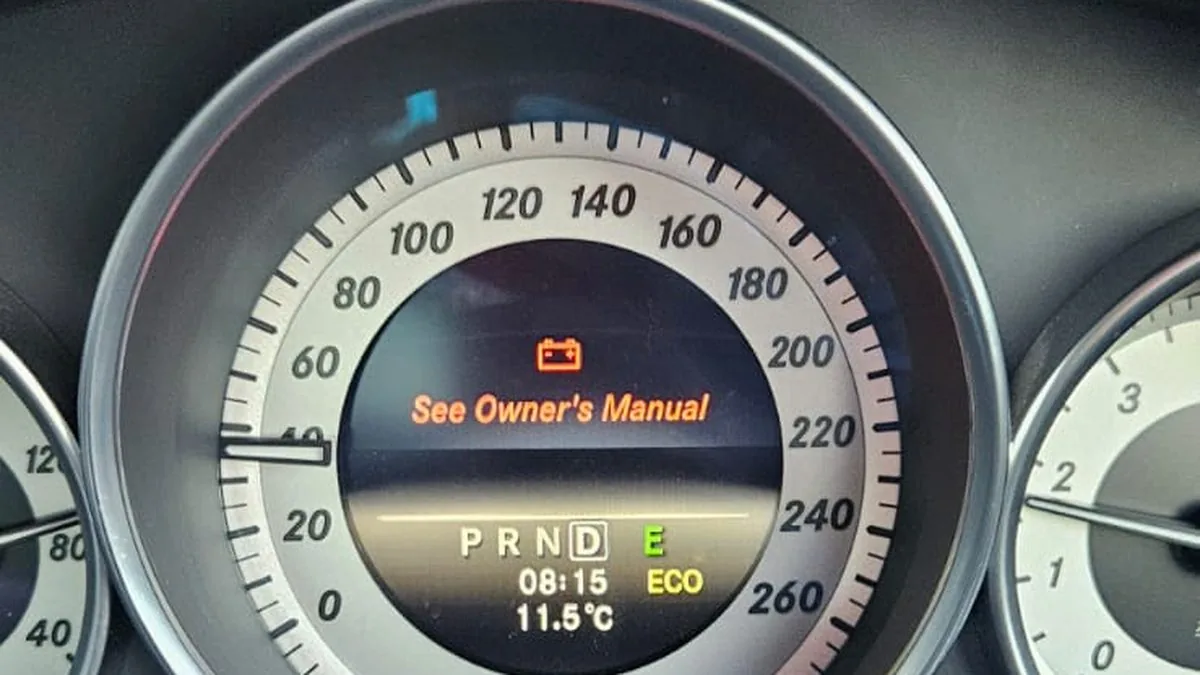
- Battery or charging: a battery symbol, usually red. Means the charging system isn’t keeping the battery topped up. The car may still run for a while on battery power alone, but it will eventually stall.
- Brake warning: an exclamation mark inside a circle, or “BRAKE” text, usually red. Can mean low brake fluid, worn pads, or the handbrake left on. Treat this one as urgent until you know which it is.
- ABS: “ABS” in a circle, usually amber. Your normal brakes still work, but the anti-lock system may not, which matters most on wet roads or in an emergency stop.
- Tyre pressure (TPMS): a tyre cross-section with an exclamation mark, usually amber. One or more tyres are low. Check pressures as soon as you can; a slow puncture is a common cause.
What is usually causing it
The same light can come from more than one cause, which is exactly why guessing from a symbol chart only gets you so far. A check-engine light can be a loose fuel cap or a faulty sensor. We diagnose before we quote. A battery light can be a loose terminal or a failing alternator. Reading the actual fault code is the only way to know which one you’re dealing with, and that needs a proper scan tool, not a look under the bonnet.
What happens if you leave it
Leaving a red light unchecked is where the real cost comes in. Driving on low oil pressure or an overheating engine can turn a repair into a full engine rebuild, which is far more expensive than an early fix. A brake warning ignored is a safety risk every time you’re on the road, not just a cost risk. Amber lights are less urgent, but they don’t fix themselves. A tyre pressure warning left alone raises your risk of a blowout. A check-engine light left alone for months can mean a small sensor fault has been allowed to affect other parts of the engine, turning a quick fix into a bigger bill.
What to do now
- Red light, engine running rough, or a burning smell: pull over safely and switch off. Don’t keep driving to get home first.
- Red light, car seems to be driving normally: get it to a workshop as soon as you can, ideally the same day.
- Amber light, car driving normally: it’s safe to continue for now, but book a check in the next few days rather than waiting for it to get worse.
- Light is flashing: treat it as more urgent than a solid light of the same colour, whatever the symbol.
- Don’t rely on a symbol chart alone to decide what’s wrong. It tells you the system affected, not the fault. A scan tool reads the actual fault code stored by the car, which is the starting point for a real diagnosis.
Not sure which category your light falls into? Fangio Auto Service can scan the fault code and tell you what it means before you decide what to do next. Find your nearest branch to book a check.
What we do at Fangio
Both Fangio Auto Randburg and Fangio Auto Hermanus run a proper car diagnostic check using a scan tool that reads the fault codes your car’s computer has stored. Rather than just handing you a code number, the mechanic explains in plain language what it means, what’s likely causing it, and what it will take to fix. A diagnostic scan usually takes under an hour, and it’s the step that turns “the light won’t stop coming on” into “here’s what’s actually wrong.”
If the cause turns out to be electrical, such as a failing alternator or a battery not charging properly, Fangio Auto Hermanus has an auto electrician on site to deal with it directly. Fangio Auto Randburg refers electrical-system repairs on, so Hermanus is the branch to book with if you already suspect a battery or charging fault.
Questions people ask
What does a red light on my dashboard mean?
Red means stop and act. It’s warning you about something that can cause damage, or become unsafe, if you keep driving without checking it.
What’s the difference between a red and an amber warning light?
Red needs action now. Amber means book a check soon, but it’s not an emergency in the moment.
Can I keep driving with a warning light on?
With an amber light and the car driving normally, yes, for a few days while you book a check. With any red light, get it looked at as soon as possible, and pull over if the car is running roughly or you smell something burning.
Does it matter if the light is flashing instead of solid?
Yes. A flashing light is more urgent than a solid one of the same symbol and colour, and usually means stop driving sooner rather than later.
My check-engine light is on but the car feels fine. Is it serious?
It could be minor, such as a loose fuel cap, or it could be more serious. The only way to know is to read the actual fault code, which is what a diagnostic scan does.
Can a scan tool tell me exactly what’s wrong?
It tells you the fault code the car has stored, which points to the system and likely cause. From there, a mechanic checks that system to confirm the actual fault before quoting.
Book a check
If a dashboard light has come on and you’re not sure what it means, don’t guess from a symbol chart. Fangio Auto Randburg and Fangio Auto Hermanus can both scan the fault code and explain it in plain language before any work is quoted. Find your branch’s phone number, WhatsApp, address and hours to book a diagnostic check.
Already have a quote?
Get an honest second opinion
Send it over and we’ll review it, explain it plainly, and beat it where we can.