The quick comparison
The fastest way to split these two apart is to notice when the trouble happens.
A starting problem usually shows itself the moment you turn the key. A charging problem usually shows itself while you are driving, or shortly after you switch off.
| What you notice | What it points at first |
|---|---|
| One click and nothing else | Battery charge, cables and connections, then the starter circuit |
| Slow, heavy cranking | Battery condition, connections, then starter current draw |
| The starter spins but the engine does not turn over | Starter engagement |
| Battery warning light appears while driving | Charging system |
| The car starts, then dies a while later | Charging system |
| A new battery keeps going flat | Charging, a drain, or a battery that was never the real fault |
Treat that table as a pointer, not a diagnosis. DENSO’s guidance for this exact job is that the battery must be visually inspected, fully charged and performance tested before anyone diagnoses a starter or an alternator. A tired battery imitates both parts convincingly, and that is how people end up paying for the wrong one.
What each part actually does
Three parts share this work, and blaming one without checking the others is where the money goes.
The battery stores energy and delivers the very large, very short burst needed to turn the engine over.
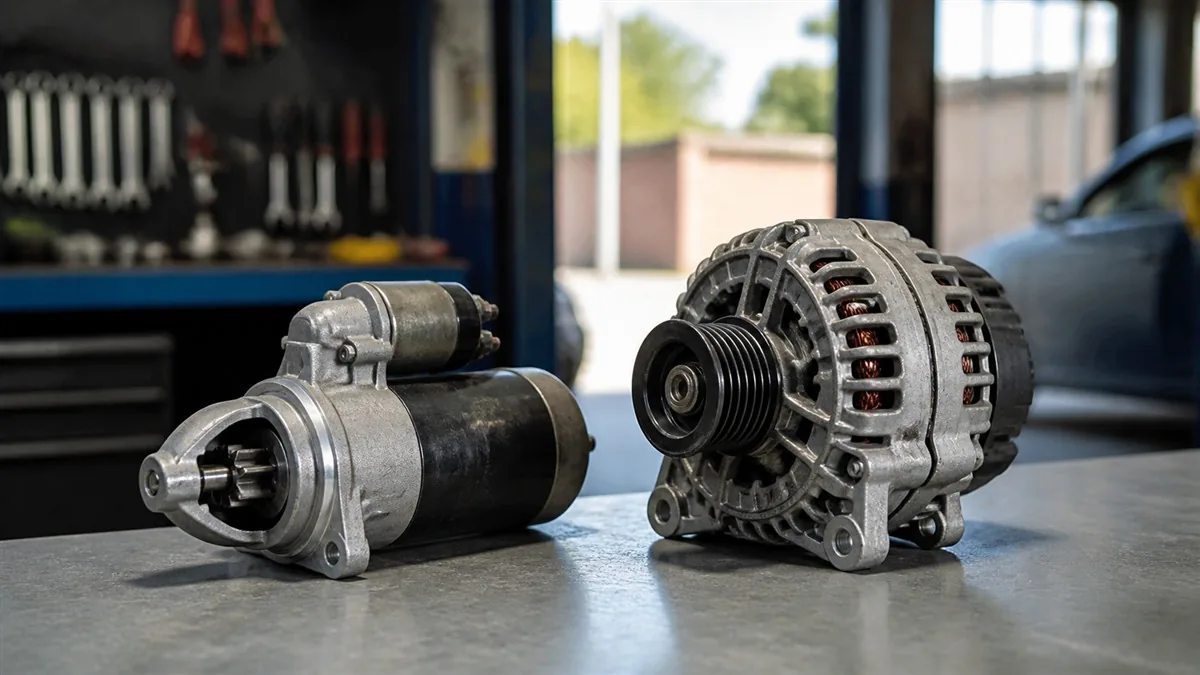
The starter motor uses that burst. It engages a gear with the flywheel, spins the engine fast enough to fire, then disengages.
The alternator takes over once the engine is running. It powers what you have switched on and puts back what starting took out.
They lean on each other. A weak battery makes a healthy starter sound sick. A charging system that has stopped doing its job runs the car off the battery instead of replacing what is being used, so even a healthy battery is drawn down while you drive. That shared dependency is the reason one symptom on its own rarely names the culprit.
Symptoms that lean towards the starter
HELLA’s starter checking guidance describes three patterns worth knowing.
- No response at all when you turn the key.
- A clack or clatter without the engine turning, where the drive tries to engage and does not.
- The starter spinning freely without turning the engine, so you hear it working but nothing else happens.
Alongside those, drivers often report cranking that has become noticeably slow and heavy, or starting that works one day and does nothing the next.
Now the important caution. DENSO notes that a single click can also come from low voltage, from wiring and earth problems, or from worn solenoid contacts. So a click tells you the starting circuit tried and failed. It does not prove the starter motor is the failed part. Anyone quoting you a starter on the strength of one click has skipped the tests that decide it.
Symptoms that lean towards the alternator
The classic one is the battery warning light coming on while you are driving. That light is usually not telling you the battery has died. It is telling you the charging system has stopped doing its job, so the car is now running on whatever the battery still holds.
Other patterns that point the same way:
- The car starts normally, runs for a while, then dies and will not restart.
- It runs after a jump-start only while the leads are connected, or dies soon after they come off. That raises suspicion about the charging side, but on its own it does not identify the failed part.
- A battery that keeps going flat even though it is new.
- Lights and electrics that dim or behave oddly while the engine is running.
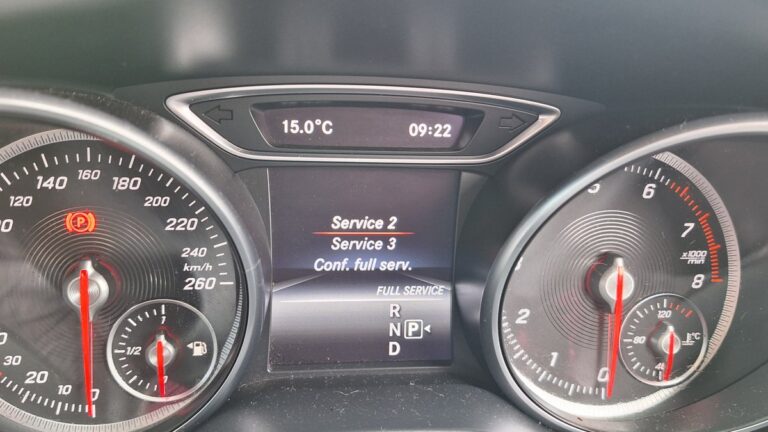
Warning behaviour is not identical across makes and models, and some cars pair a charging warning with their own separate messages. Our guide to the Mercedes auxiliary battery malfunction warning is a good example of a battery-related message on a modern car that has its own distinct cause.
Your vehicle handbook is the authority on your own car. Whatever it says a warning light means, and what it tells you to do about it, takes priority over any general symptom guide, including this one.
The lookalikes: battery, cables and earths
Before a starter or an alternator is condemned, the boring stuff has to be ruled out. Battery, cable and earth faults are common lookalikes. They produce the same noises and the same no-start that people blame on a starter or an alternator, so they have to be cleared first.
- A battery that is discharged, aged, or has lost capacity.
- Corroded, dirty or loose terminals, which can drop enough voltage to mimic a dead starter.
- Damaged or poorly connected earth straps and heavy cables, where the fault is the path rather than the part at either end.
- A drain flattening a good battery while the car is parked.
DENSO is explicit about the order. Inspect, charge fully, then performance test the battery before diagnosing anything else. Skip that and every later reading is being taken against a supply nobody can trust.
What a proper starting and charging test checks
A workshop doing this properly moves in a sequence instead of swapping parts.
- Take the symptoms honestly. What you hear, when it happens, whether it is getting worse, and what the dash shows.
- Inspect the battery, terminals, clamps, earth straps and heavy cables for corrosion, damage and looseness.
- Charge the battery fully, then performance test it, so the rest of the testing sits on a known supply.
- Measure voltage drop across the starting circuit while cranking. This is what separates a bad cable or earth from a bad part.
- Check the starter’s current draw and behaviour under load rather than judging it by ear.
- Test charging output and control with the engine running and under electrical load.
- Scan for stored faults where the vehicle monitors the charging system electronically.
- Only then decide the repair, and retest afterwards to confirm the fault is genuinely gone.
Steps two to four are where a fair number of these jobs turn out to be a connection or an earth rather than a part. That is a much smaller repair, and you only find it by testing.
One safety note. Please do not go probing a starting or charging circuit yourself. These circuits carry very high current, the heavy cables stay live with the key out, and a slip across a terminal can burn you, damage electronics or start a fire. Spotting symptoms is useful. Hands in the circuit is workshop work.
When you should stop driving
If the battery warning light comes on while you are driving, treat it as a countdown rather than a suggestion. The car is running on stored energy, and when that runs out it can stop wherever it happens to be.
Stop and arrange help rather than pressing on if any of this joins in: a hot or burning electrical smell, smoke, a red warning light, a temperature gauge climbing, or steering and braking that feel different once the engine has cut. Do not set off on a long trip, at night, or onto a highway with a charging warning showing.
If the car will not start at all and you are somewhere unsafe, get it recovered rather than cranking it over and over. Repeated long cranking heats the starter and uses up whatever charge is left.
Common questions
Is one click the starter or the battery?
It can be either, and it can also be a cable, an earth or the solenoid contacts. A click means the circuit tried and could not deliver. Voltage drop testing while cranking is what tells you which link in that chain failed.
Can an alternator fault stop the car from starting?
Yes, indirectly. If the alternator has not been charging, the battery ends up too flat to crank. The starting failure is then a symptom, and replacing the starter would change nothing.
Why does my new battery keep going flat?
The usual reasons are a charging system that is not charging properly, a drain on the car while it is parked, or a connection problem that stops the battery ever reaching a full charge. A battery is often the victim rather than the fault.
If a jump-start works, does that prove it was the battery?
No. A jump-start proves the engine will turn and run when enough current is available. It does not say why the current was missing, and it does not identify the failed part. If the car dies again soon after the leads come off, that raises suspicion about the charging side, but only testing confirms it.
Should I just replace both and be done with it?
That is the most expensive way to guess, and it still misses cable, earth and drain faults. Testing first is cheaper than replacing twice.
How do I know if it’s an alternator or starter problem?
Notice when the trouble happens. A starting problem usually shows up the moment you turn the key: a click, slow or heavy cranking, or the starter spinning without turning the engine. A charging problem usually shows up while you are driving or shortly after you switch off: a battery warning light, the car dying and not restarting, or a new battery that keeps going flat. Either way, the battery gets tested first, since a tired one can imitate both faults.
Book a battery or starter motor replacement in Randburg
If you have been searching for starters and alternators near me, our Randburg branch can replace a failed battery or starter motor. It does not do electrical fault finding. If the cause is not clear, such as a battery that keeps going flat or a wiring fault, that work is done by the auto electrician at our Hermanus branch: see auto electrical repairs.
Tell us the make, model and year, what you hear when you turn the key, whether the battery light comes on while driving, and whether the car has been jump-started recently. That detail helps us confirm the right part before we replace it. You can also browse our other car repairs in Randburg, or use our contact page if you would rather send the details in writing.
Fangio Auto Randburg, working on cars in Blairgowrie since 2009.
- Phone 011 326 3133
- WhatsApp 082 402 3517
- 110 Susman Ave, Blairgowrie, Randburg
- Monday to Friday, 07:30 to 16:30. Closed Saturday, Sunday and public holidays.
If the car will not start where it stands, say so when you make contact and we will talk through the options first.
Already have a quote?
Get an honest second opinion
Send it over and we’ll review it, explain it plainly, and beat it where we can.