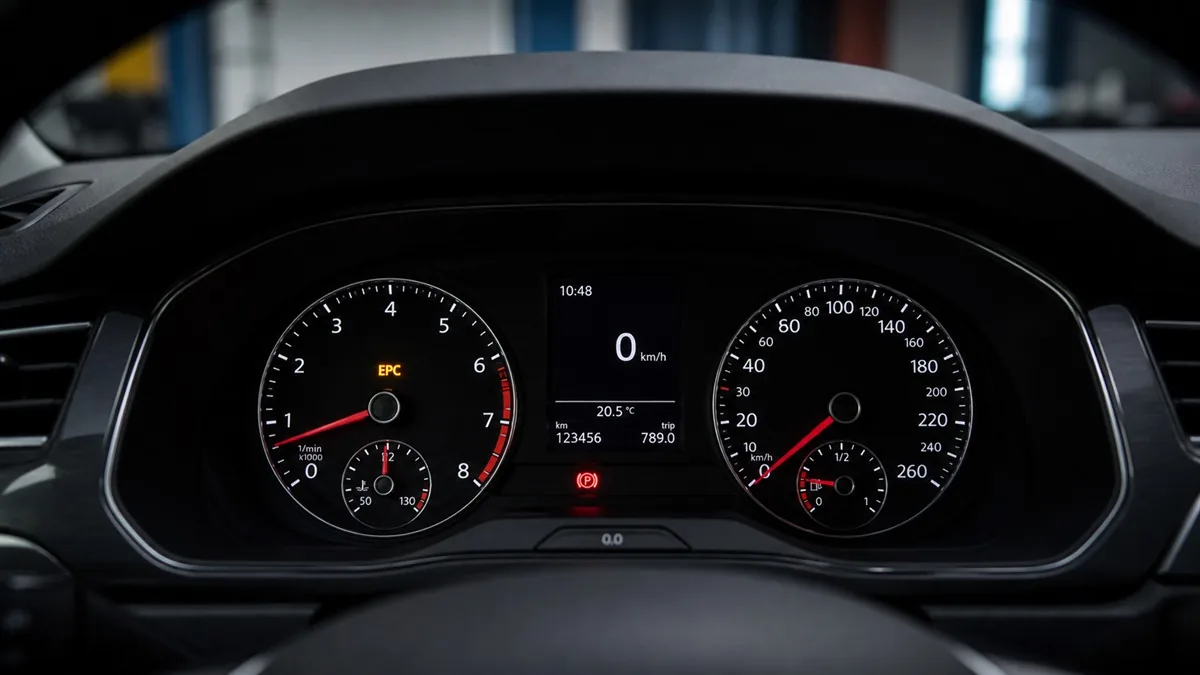
EPC stands for Electronic Power Control. It is an amber warning used mainly on petrol Volkswagen Group cars, so Volkswagen, Audi, SEAT and Skoda, and Volkswagen’s own warning-light guidance classifies it as an engine-control malfunction.
The important part is what it does not tell you. EPC reports a fault, it does not name the part. Two cars showing the same light can have completely different faults behind it, which is why the expensive mistake after an EPC warning is buying a component on a guess.
What EPC stands for and what it covers
Electronic Power Control. It covers the electronic side of engine management on the petrol engines that use it, meaning the chain of sensors, control signals and actuators that decide how much air and fuel the engine gets and how the throttle responds to your right foot.
Volkswagen’s current warning-light guidance treats EPC as an amber engine-control malfunction, and says the meaning can vary between models. A Volkswagen Group warning-icon guide published by Skoda expands the abbreviation as Electronic Power Control, calls it a petrol-engine fault, and warns the car may drop into an emergency running mode that reduces engine power. A SEAT owner manual describes the lamp as monitoring electronic engine management on petrol engines.
So the exact behaviour is model specific. Your owner manual and the message on your cluster outrank any general article, including this one. If your cluster is showing words next to the symbol, write them down first.
When the light at ignition is normal
Switch the ignition on without starting the engine and a row of warning lights comes on together. That is the cluster self-check. The SEAT owner manual for this lamp describes it coming on with the ignition and going out once the engine is running, so a lamp that behaves that way is doing what it is supposed to do.
The sequence matters, not the lamp on its own.
| When the EPC lamp behaves like this | What it means for you |
|---|---|
| On at ignition, out shortly after the engine starts | Normal self-check behaviour. Nothing to act on. |
| On at ignition and still on after the engine starts | A fault is stored. Check the cluster message and your manual, then book a scan. |
| Comes on while you are already driving | Treat this as the serious case. SEAT’s manual guidance for this lamp is to stop and get technical help. |
Your own manual has the final say on all three, because the meaning can vary by model.
What a steady EPC warning means
A lamp still lit after the engine is running means the control unit has stored a fault. The car may drive normally, and plenty do. That does not mean the fault has gone away, only that the system has not had to protect the engine yet.
It also means there is likely to be data sitting in the car. A suitable scan can retrieve the stored fault codes, and where the vehicle and the code support it, freeze-frame or snapshot data showing the conditions at the moment the fault was recorded. That is the shortest route to the real cause, and it is why a scan comes before any parts conversation.
Symptoms that change the risk
The light alone is only half the picture. What the car is doing alongside it is the other half.
- Light on, car drives normally. A fault is still stored. Check the cluster message and what your manual says for your model rather than assuming it is minor, and get it scanned soon. An intermittent fault can be harder to reproduce later, so it is worth scanning while useful data may still be stored.
- Noticeably reduced power or a heavy, unresponsive accelerator. This is the emergency running mode the Volkswagen Group guidance describes, where output is limited to protect the engine.
- Rough running, hesitation, stalling or a misfire feel. The engine is not running properly, not just reporting a fault.
- EPC together with the engine management light. One underlying fault can set both lamps, so two lights do not automatically mean two separate problems. It does mean the fault is worth reading properly. A flashing engine management light is model specific and can point to a misfire serious enough to damage the catalytic converter, so check what your manual says for that symbol and follow it.
- Light appears while you are driving. SEAT’s owner manual guidance for this lamp is to stop and get technical help when it comes on during driving.
When to stop driving
Pull over somewhere safe as soon as you can if any of the following apply.
- Engine power drops suddenly, especially on a highway or in fast traffic.
- The accelerator stops responding normally.
- The engine is misfiring, shaking or stalling.
- A warning light is flashing rather than steady.
- You can smell burning, see smoke, or the temperature gauge is climbing.
Safe means off the road, out of a live lane, hazards on. If the car is unsafe to drive, it is unsafe to drive to the workshop, so call for a tow.
Outside those conditions there is no safe general rule, because the meaning varies by model. Read the exact message on your cluster, follow what your own owner manual says for your car, and book the diagnosis rather than ignoring the lamp.
Fault areas, without guessing the failed part
EPC sits across the whole engine-management chain, so the honest answer to “what causes it” is a list of areas, not a part.
- The driver input side, meaning the signals that tell the engine how hard you are pressing the accelerator.
- The throttle control side, meaning the electronics that open and close the throttle in response.
- Engine sensor signals feeding the control unit, where a reading outside the expected range gets rejected.
- Ignition and fuel delivery, which is where rough running and misfire complaints usually sit.
- Switches and inputs the control unit cross-checks against each other, where one disagreeing signal is enough to set a fault.
- Wiring, connectors, earth points, and battery and charging voltage. Poor voltage or a corroded connector can upset several signals at once and imitate a failed component.
Owners often arrive having already read that it is the throttle body, the pedal sensor or the brake-light switch. Those all sit in this same chain, which is why they come up. Naming one before the codes are read is still a guess.
Why clearing the code or disconnecting the battery is not a repair
Neither one is a repair. Clearing a code or disconnecting the battery changes nothing about the condition that set the warning, so it can return the next time the fault occurs.
Disconnecting the battery is the worse of the two. It may not clear an EPC warning at all, and on modern cars it can reset learned settings and stored values that the vehicle built up over time, or bring up other warnings and systems that then need attention of their own. Do not pull a battery terminal just to switch a light off.
Clearing also damages the diagnosis. It wipes the stored codes and any snapshot data the vehicle held, which is often the most useful evidence available, especially for an intermittent fault that will not misbehave on demand in a workshop. Erase it and the next technician starts from nothing, which usually means more diagnostic time, not less.
If the light is on, leave it on and bring the car in as it is.
How a workshop should diagnose it
A proper diagnosis follows an order, so the evidence chooses the part rather than the other way round.
- Take the history. Exact cluster message, when the light appeared, at start-up or while driving, steady or flashing, what the car was doing.
- Scan every control unit, not only the engine. Record the codes before anything is cleared.
- Read the freeze-frame or snapshot data when available, since not every vehicle stores it for every code, so the conditions at the moment of the fault are known where the car recorded them.
- Watch live data with the engine running and on a road test, comparing what the control unit asked for against what actually happened.
- Check the physical layer. Wiring, connectors, earth points, battery and charging condition, visible damage or moisture.
- Test the suspected component directly, only once the data points at it.
- Repair, then clear and re-test on a road test, under the conditions that set the fault.
Our car diagnostics page explains the scan side, and our Volkswagen service and repairs page covers the make more broadly.
What decides the cost
There is no single price for an EPC light, because the light is not a repair. What the job costs depends on:
- How long it takes to reproduce the fault. One that is present all the time is quicker to pin down than one that appears once a week.
- Whether there is one code or several across different control units.
- Whether the fix is a connector, an earth point or a wiring repair rather than a replacement component.
- Which component it is, and how available parts are for your model and engine.
Diagnostic time and repair work are two different things. Ask for the codes in writing, and for the repair quote after the diagnosis rather than before it.
Get the EPC light read at Fangio Auto Service
We diagnose from the car’s stored data, not from the shape of the symbol on your dashboard.
Have this ready when you book:
- Make, model, year and engine, and whether it is petrol
- The exact wording on the instrument cluster
- Whether the light came on at start-up or while driving
- Steady or flashing, and any other warning lights on at the same time
- Any power loss, rough running, hesitation or stalling
- When it started, and whether it goes out and comes back
Choose the branch nearest you and bring the car in as it is, without clearing the code:
Not sure which branch suits you? Send the vehicle details through our contact page.
FAQ
What does EPC stand for?
Electronic Power Control. It is a warning that the electronic engine management system has recorded a fault on the petrol models that use it.
Is EPC only a Volkswagen light?
It is a Volkswagen Group warning, so you will see it on Volkswagen, Audi, SEAT and Skoda petrol models. Other makes use different names for comparable faults. Volkswagen’s guidance notes the meaning can vary by model, so your owner manual is the final word.
Is it normal for the EPC light to show before the engine starts?
Yes. The SEAT owner manual for this lamp describes it coming on with the ignition and going out once the engine is running. A lamp still on after the engine starts is the one to act on.
Can I drive with the EPC light on?
That depends on your model and what the car is doing, so the cluster message and your owner manual decide it, not a general rule. SEAT’s owner manual guidance for this lamp is to stop and get technical help if it comes on while driving. Stop as soon as it is safe if power drops, the accelerator stops responding normally, the engine runs roughly or stalls, a warning light is flashing, or you see smoke or a rising temperature gauge. Either way the fault is stored and should be read.
Will disconnecting the battery fix the EPC light?
No, and it is not a repair. It may not clear the warning at all, it does not change the condition that set it, and it can reset learned settings or bring up other warnings. It also erases the codes and any snapshot data a technician needs.
Does an EPC light mean my throttle body has failed?
Not on its own. The throttle side is one of several areas the warning covers, along with accelerator input signals, sensor readings, ignition and fuel delivery, and the wiring feeding all of them. The codes and live data decide which.
Already have a quote?
Get an honest second opinion
Send it over and we’ll review it, explain it plainly, and beat it where we can.