Brake disc skimming is the cheapest honest way to fix a scored or shuddering brake disc, and it is also the repair most often sold to drivers whose discs should simply have been replaced. The difference between those two outcomes comes down to one measurement taken before anything is cut. This guide explains when a skim is the right call, when it is a waste of money, and what a proper inspection should tell you.
Can You Skim Brake Discs? The Short Answer
Yes, you can skim brake discs, but two conditions must both be met.
First, the disc must still be above the manufacturer’s minimum thickness after the metal is removed, not before. Every disc carries a minimum thickness figure, usually stamped into the disc hub or edge and listed in the vehicle’s service manual. Skimming takes material off both faces, so the question is never “is it thick enough now” but “will it still be legal once we have cut it”.
Second, the damage must be surface damage. Light scoring, mild ridging and minor uneven wear machine out cleanly. Cracks, heat-checked surfaces, deep grooves and severe warping do not.
When both are true, brake disc skimming restores a flat, even braking surface for meaningfully less than a new set of discs. When either one fails, replacement is not the upsell. It is the only safe answer.
What Brake Disc Skimming Actually Is
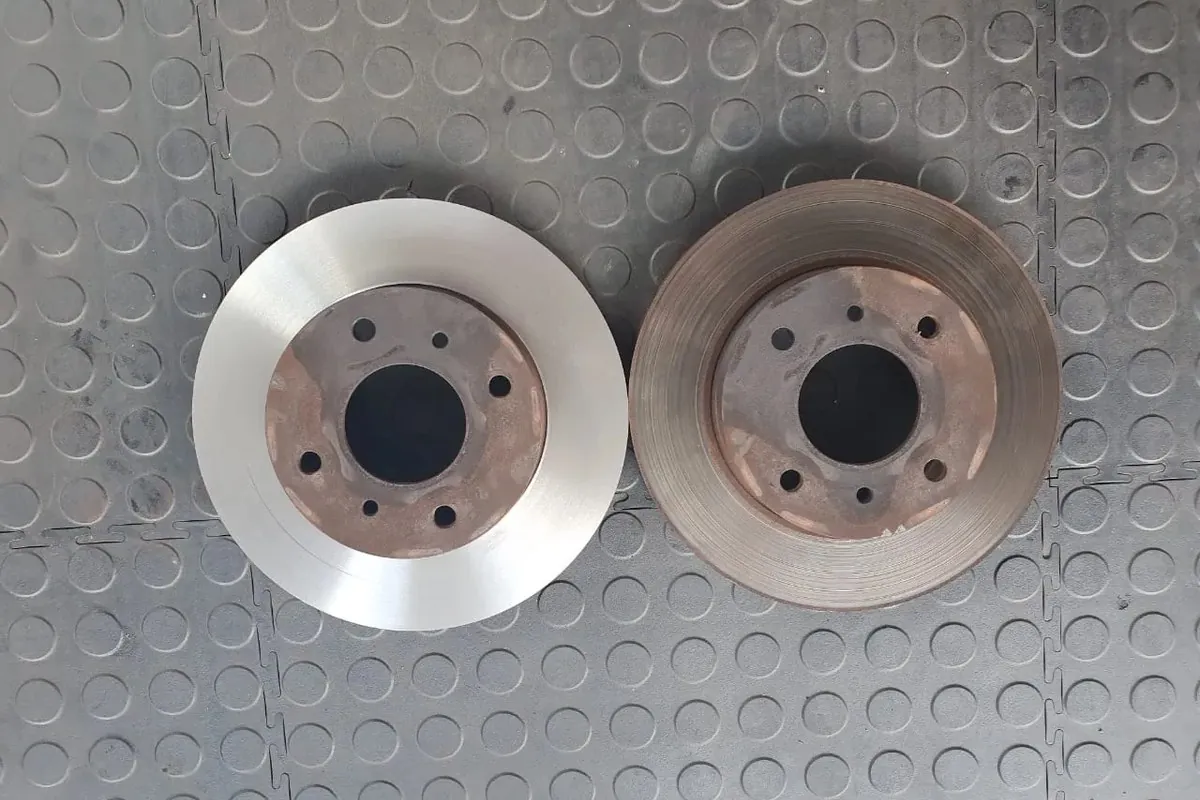
Skimming, also called resurfacing or machining, removes a thin, even layer of metal from both faces of the disc on a lathe. The point is not to make the disc look new. The point is to make it flat and parallel again.
Two separate faults get fixed by the same cut:
- Scoring: grooves cut into the face by worn-out pads, grit, or a pad that has worn down to its backing plate. Grooved discs give the pad less contact area and chew through new pads quickly.
- Disc thickness variation: the disc is fractionally thicker in some places than others, so the pads grip harder and softer as the disc rotates. This is what you feel as shudder through the pedal or steering wheel. Drivers and workshops both tend to call it a “warped disc”, but true warping is rare; uneven thickness is the usual culprit.
A skim cures both by cutting the disc back to a single true plane.
How a Brake Disc Skim Is Done
Step 1: Measurement, before anything is cut. A micrometer reads disc thickness at several points around the face, and a dial gauge checks runout: how much the disc wobbles as it turns. These two numbers decide whether the job goes ahead at all. Any workshop that quotes you for skimming without measuring first is guessing.
Step 2: The cut. The disc is machined on a lathe, taking equal material from both faces so the disc stays balanced and parallel. At Fangio Auto Service the cutting itself goes to a precision skimming specialist rather than being done in-house, because a precision lathe gives a better finish and a tighter tolerance than a general workshop setup. Our Hermanus branch does not machine discs at all and will normally recommend replacing the disc instead. On-car machining, where the lathe is bolted to the vehicle and cuts the disc in place, is also available at our Randburg branch through a specialist company that comes to the workshop. If you want to understand the difference between the two methods and when each one matters, see our guide to on-car versus off-car brake disc machining.
Step 3: Re-measure and refit. The disc is measured again after cutting to confirm it is still above minimum thickness, then refitted and checked for runout. New pads go on at the same time. A freshly machined disc paired with old, glazed pads will not bed in properly, and you will be back with the same complaint.
Two things worth knowing before you approve the job. Discs are machined in axle pairs, never one side only, because uneven disc thickness left to right makes the car pull under braking. And the cut itself is quick, typically under an hour, though your total turnaround depends on the workshop’s schedule and the trip to the machining specialist.
The Honest Pros and Cons of Disc Skimming
| Pros | Cons |
|---|---|
| Costs less than a new set of discs when the disc qualifies | Every skim permanently removes metal and shortens the disc’s remaining life |
| Cures shudder and scoring without replacing good hardware | A thinner disc holds and sheds less heat, so it is more prone to fade and distortion under hard or repeated braking |
| Quick: the cut itself is usually under an hour | Most discs can only take one skim, sometimes two; after that it is replacement regardless |
| Reuses a serviceable part instead of scrapping it | You can pay for the inspection and still be told the disc must be replaced |
| Restores full pad contact, so new pads wear evenly | If the real fault is hub runout, a sticking caliper or uneven pad deposits, the shudder comes back within months |
Two of those cons deserve expanding, because they are the ones that cost drivers money.
Modern discs often have almost no machining allowance. Manufacturers have been making discs lighter, which means the gap between new thickness and minimum thickness can be very small across both faces. On plenty of current vehicles there is simply no metal to spare, and a skim was never on the table.
A skim does not fix a fault that lives somewhere else. If the hub face is dirty or the wheel bearing has play, the disc will run untrue the moment it is bolted back on, and thickness variation will build again over the next few thousand kilometres. That is why the runout check matters as much as the thickness check.
Arrive Alive recommends inspecting brakes at least twice a year, and any time braking feel or pedal response changes.
When Skimming Is Not an Option
Replacement is the right call when:
The disc is at or below minimum thickness. A disc that is too thin can overheat, distort or crack under hard braking. There is no version of this that ends well.
The disc has deep grooves, cracks or heat spots. Blue or purple discolouration means the disc has been heat-cycled beyond what the metal tolerates. Machining the surface does not undo that.
The disc is warped beyond what the lathe can correct. Severe distortion usually means thermal stress the disc will not recover from.
There is no machining margin left in the design. As above, on some vehicles the numbers simply do not allow it.
The AA South Africa lists brakes as an essential safety item and recommends regular inspection.
Skimming vs Replacing: Which Is Better Value?
The deciding question is how much disc life is left.
Skim when the discs have plenty of metal above minimum, the damage is superficial, and the discs are otherwise in good condition. You get the fault fixed for less and the discs go on to give reasonable service.
Replace when the discs are already well worn, have been skimmed once before, or are close enough to minimum that a cut leaves them marginal. Skimming these buys you months, not years, and you end up paying for the labour twice.
There is a middle case worth naming honestly: discs with a lot of life left but only mild scoring often need nothing at all beyond new pads. A competent inspection should be willing to tell you that.
At Fangio Auto Service we measure and then tell you which of the three you are looking at. If a skim is not an option, see our brake repair page for what a full disc replacement includes.
Can You Skim Brake Discs Yourself?
Realistically, no, not because the principle is complicated, but because the tolerances are not achievable without the equipment.
A disc has to come out flat, parallel and true to a very tight tolerance. That needs a proper brake lathe, correctly set up, plus a micrometer and dial gauge to verify the result. Removing and refitting the discs is within reach of a home mechanic with the right tools, but the cut itself is not a garage-floor job, and a disc machined out of true is more dangerous than the scored disc you started with.
The sensible DIY contribution is the inspection: measure your own discs against the stamped minimum before you book anything, so you walk in knowing whether a skim is even possible.
Signs Your Brakes Need Attention
- Vibration or shudder through the pedal or steering wheel when slowing down: usually disc thickness variation, and the classic reason to ask about skimming.
- Grinding or metallic scraping: pads worn through to the backing plate. The discs are being cut as you drive, and this often ends in replacement rather than a skim.
- A visible lip around the outer edge of the disc: the disc face has worn down while the unswept edge has not.
- Longer stopping distances or a soft, sinking pedal: get this checked immediately; it may not be the discs at all.
If you are getting shudder, do not leave it. The longer uneven thickness runs, the more likely you cross from “can be skimmed” into “must be replaced”.
Frequently Asked Questions
How much does brake disc skimming cost in South Africa?
It varies by vehicle and workshop, but skimming is consistently cheaper than a new set of discs. Ask for a quote that includes the inspection, so you find out whether your discs actually qualify before any work is committed. A quote given without a measurement is not a quote, it is a guess.
How long does brake disc skimming take?
The machining itself is usually under an hour. Total turnaround depends on the workshop’s schedule and, where the cutting is outsourced to a precision specialist as it is at Fangio, the time to get the discs there and back. Your workshop should give you a realistic time when you book.
How many times can a brake disc be skimmed?
Usually once, occasionally twice, and on some modern vehicles not at all. It depends entirely on how much metal sits between the disc’s new thickness and its stamped minimum. Once that margin is used up, replacement is the only option.
Can I drive on grooved brake discs?
Lightly grooved discs still work, but they reduce braking efficiency and wear new pads out quickly. Deep grooves or a pronounced edge lip mean the disc needs attention now, not at the next service.
How do I know if my discs are too thin to skim?
A mechanic measures thickness with a micrometer at several points and compares it against the manufacturer’s minimum, which is stamped on the disc. The test is whether the disc will still clear that minimum after the cut, not before.
Do brake discs have to be skimmed in pairs?
Yes. Both discs on an axle are machined together so braking stays even side to side. Skimming one and leaving the other invites the car to pull under braking.
Do I need new pads when discs are skimmed?
Yes. Old pads carry a wear pattern matched to the old disc surface and are usually glazed. Fitting them to a freshly machined disc gives poor bedding-in and often brings the original complaint straight back.
What is the difference between skimming and replacing brake discs?
Skimming machines the existing disc back to flat. Replacing fits new discs. Skimming is faster and cheaper when the disc has metal to spare, but a new disc will always outlast a skimmed one, and a skimmed disc starts its second life already closer to the scrap limit.
Book Your Brake Check at Fangio Auto Service
If you are not sure whether your brake discs can be skimmed or need replacing, we will measure them and give you a straight answer. We inspect, measure and advise honestly, so you are never paying for work your vehicle does not need, including telling you when the answer is “new pads and nothing else”.
Two branches ready to help. In Randburg, call 011 326 3133 or WhatsApp 082 402 3517. In Hermanus, call 087 164 1041 or WhatsApp 060 616 2948. You can also contact us online to book your brake inspection.
Brake shudder does not fix itself, and it gets more expensive the longer it runs. A measurement now decides whether this is a skim or a replacement.
Already have a quote?
Get an honest second opinion
Send it over and we’ll review it, explain it plainly, and beat it where we can.