If your steering wheel shudders or the brake pedal pulses when you slow down, you have probably already searched for that on its own. This article picks up where that one leaves off: what people mean when they say a disc is “warped,” and whether it is the bent-metal problem it sounds like. It is common, and in most cases it is safe to keep driving to a workshop, but it does get worse the longer you leave it. Here is what is actually happening and what to do about it.
What you are noticing
Warped discs rarely show up as one dramatic symptom. They build up gradually, usually in this order:
- A slight pulse in the brake pedal when you brake from higher speed, easy to miss at first
- The steering wheel starts to shudder or vibrate, especially braking from highway speed
- The pulsing gets stronger and happens at lower speeds too
- A faint judder you can feel through the whole car, not just the wheel or pedal
- In worse cases, a scraping or grinding sound alongside the vibration
If you are only feeling this and have not yet worked out what it means, that is normal. Most drivers notice the shudder for weeks before they look into the cause.
What is usually causing it
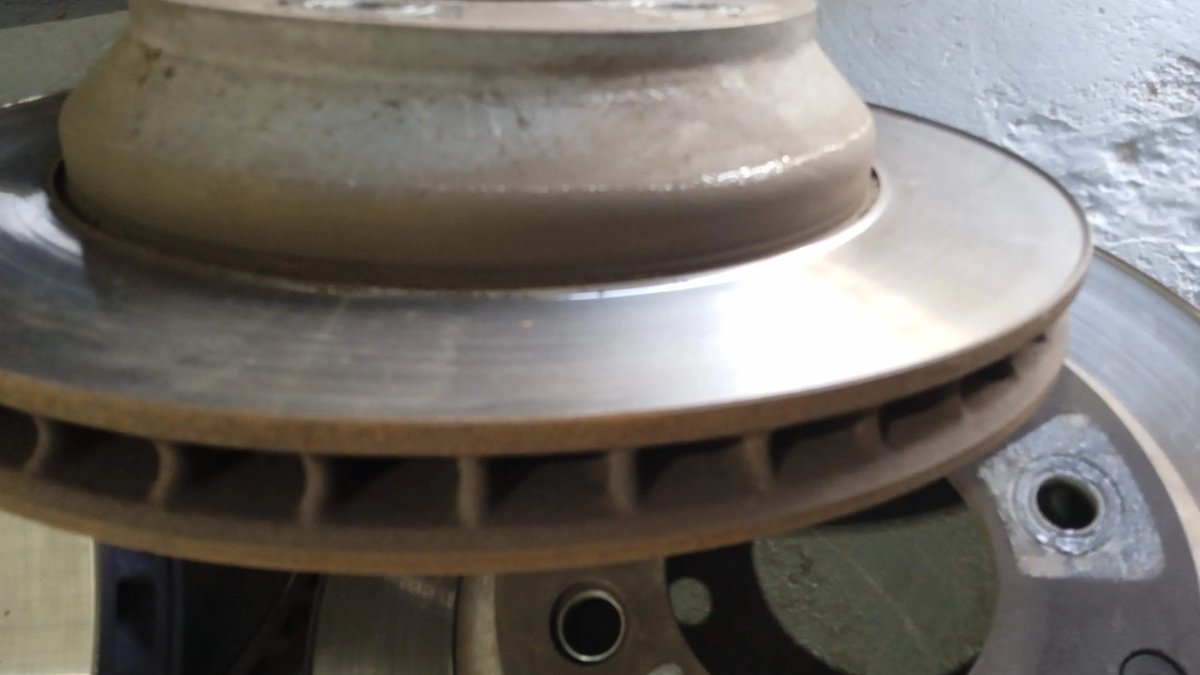
“Warped” suggests the disc has physically bent, like a dinner plate left in the sun. That is almost never what has happened. In nearly all cases, the disc is still flat. What has changed is its thickness or its evenness across the face, and that unevenness is what you feel as a pulse.
Two things usually cause it:
Disc thickness variation. The disc wears unevenly across its surface, so it is thicker in some spots than others. Every time the thicker section passes through the caliper, it pushes the pad back slightly and you feel that as a pulse. This is what a workshop actually measures with a dial gauge, not by eye. Our page on skimming brake discs explains that check in more detail.
Pad deposit buildup. Brake pad material transfers onto the disc face unevenly, usually from hard braking followed by sitting still with the pads pressed against a hot disc, or from a caliper that is not releasing fully. Those uneven patches create the same pulsing feeling as thickness variation, without the disc itself being damaged.
A less common cause is runout at the hub: the disc is mounted slightly off-true because of a bearing or hub problem rather than the disc itself. This is why a proper check measures the disc on the car, not just the disc on its own.
One thing this is not: a wheel balance or alignment issue. Those affect steering feel at speed, not specifically under braking. We do not sell tyres, and we do not sell balancing or alignment as a standalone service, but if your car is already in for a repair with us and it needs either of those, we handle it as part of that job.
What happens if you leave it
Driving on a disc with thickness variation will not fail suddenly, but it does not get better on its own either. Left alone:
- The uneven wear gets worse, so the pulsing gets stronger over time
- Pads wear unevenly against the high spots, shortening pad life
- Pedal feel gets less predictable, particularly under hard or emergency braking
- What could have been a skim job now needs a full disc replacement, because the disc has worn past the minimum thickness
None of this makes the car unsafe to drive to a workshop. It does mean the fix gets more expensive the longer it waits, and a car that pulses under braking is already telling you its stopping distance is less consistent than it should be.
What to do now
- You do not need to pull over. It is safe to keep driving normally and get it looked at.
- Note when it happens: only at high speed, at all speeds, with a smell or grinding sound, or only when the brakes are already hot.
- Stop and get it checked immediately if the pedal feels soft or goes lower than usual, or if you hear grinding metal-on-metal. Those point to a different, more urgent problem.
- Book a brake check rather than guessing. The only reliable way to know if it is thickness variation, pad deposits, or something at the hub is to measure it.
Book a brake check now. Both Fangio branches handle this. Contact us to book at the branch nearest you.
What we do at Fangio
We start by measuring, not guessing. The disc is checked with a dial gauge for runout and for thickness variation across the face, on the car, so a hub or bearing problem is not mistaken for a disc problem. We also check the pads and calipers, since deposit buildup and a caliper that is not releasing properly are common causes and cheaper to fix than a disc.
From there it comes down to the numbers. If the disc is still within its serviceable thickness, it can be skimmed back to a true, even surface rather than replaced. Our skimming brake discs page covers when that applies. If it has worn past the minimum, it gets replaced. Either way, pads are checked at the same time, since new or skimmed discs paired with worn pads will just cause the same problem again. A brake inspection like this is generally done within the day. Any labour we carry out comes with our 12 month / 10 000 km warranty.
If what you are actually dealing with is a squeal or a thinning pad rather than a pulse, our page on signs your brake pads need replacing covers that instead. The two problems feel different and are fixed differently. General brake work and pricing is covered on our brake repair page.
Questions people ask
Can warped brake discs be fixed without replacing them?
Often, yes. If the disc is still above its minimum thickness, skimming it back to an even, flat surface fixes the pulsing without buying a new disc. If it is already thin, skimming is not an option and it needs replacing.
How do you check if a brake disc is warped?
With a dial gauge measuring runout and thickness variation across the disc face while it is still fitted to the car. Feeling for a pulse tells you something is wrong, not what or where.
What is disc thickness variation?
It is the difference in thickness at different points around the same disc. Even a small variation is enough to cause a noticeable pulse in the pedal or steering wheel under braking.
Is a warped disc dangerous to drive on?
Not immediately. It is safe to drive to a workshop. Left unchecked, wear gets worse, pads wear unevenly, and pedal feel becomes less predictable, so it is worth booking a check rather than ignoring it.
How long do skimmed discs last?
That depends on how much material is removed and how much thickness the disc has left afterwards, which is why a workshop checks the disc is still within its serviceable limit before skimming rather than after.
Book your brake check
A pulsing pedal or shuddering wheel under braking is worth checking now rather than later. Contact Fangio Auto Service to book at Fangio Auto Randburg or Fangio Auto Hermanus, whichever is closer to you.
Already have a quote?
Get an honest second opinion
Send it over and we’ll review it, explain it plainly, and beat it where we can.