You’ve spotted a dark patch under the car on the driveway, or the dipstick came out lower than it should. Oil leaks are one of the most common reasons drivers in Randburg book a workshop visit, and most are not an emergency, but a few are. This article walks you through what is usually leaking, how urgent it is, and what to check before you decide whether to keep driving.
What you are noticing
Oil leaks show up in a few different ways, often before you connect the dots:
- A dark, oily spot on the driveway or garage floor, usually under the middle or front of the car
- The dipstick reading below the minimum mark, even though you haven’t had a service recently
- An oil warning light or low oil pressure light on the dash
- A burning smell, especially after the car has been sitting for a few minutes with the engine off
- A faint blue-grey haze from under the bonnet on a hot day
- Oil residue on the inside of a wheel, if the leak is coming from a seal near the front or rear axle
Some of these you’ll notice straight away. Others, like a slow drip from a gasket, only show up once there’s enough oil to leave a mark.
What is usually causing it
Most oil leaks in an ordinary petrol or diesel engine come from one of these:
- Oil pan (sump) gasket: the gasket sealing the oil pan to the bottom of the engine hardens and shrinks with age and heat, and starts weeping oil from the seam.
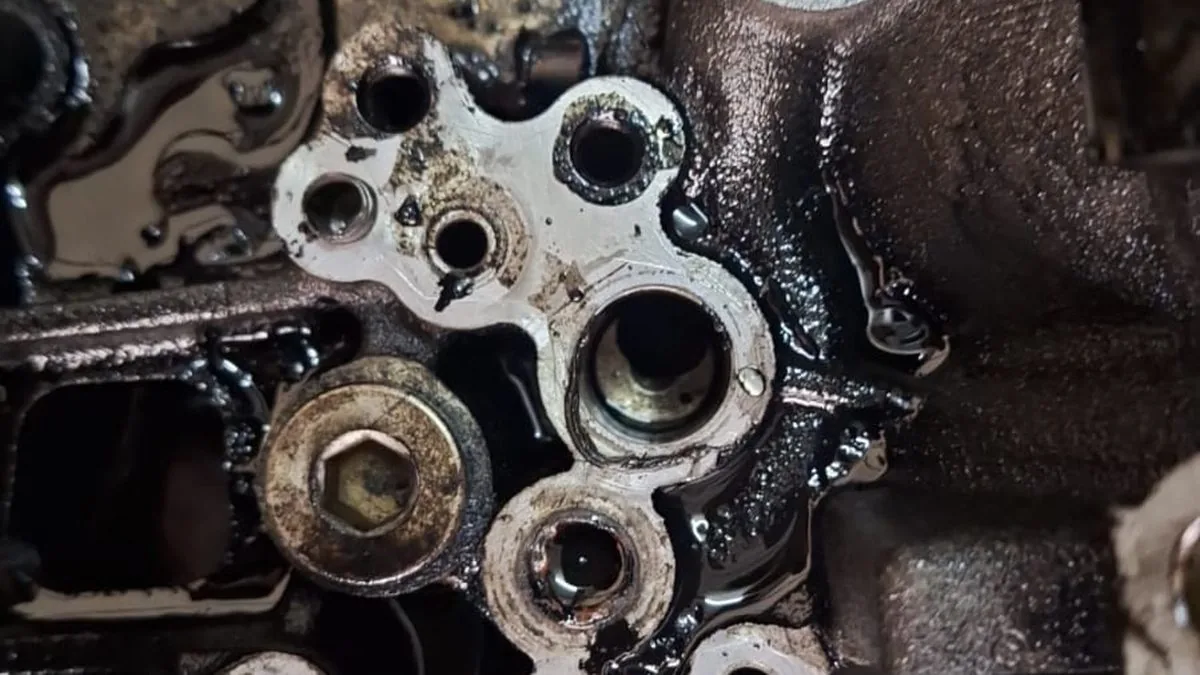
- Valve cover gasket: sits on top of the engine and is one of the most common leak points. Oil tends to run down the side of the engine block, which can make the source hard to spot without a proper look underneath.
- Front or rear crankshaft seal: these seals wear out over time and the car’s mileage. A rear main seal leak often looks like oil dripping from the middle-to-back of the engine, near where it meets the gearbox.
- Loose or worn drain plug: sometimes it’s this simple. A drain plug that wasn’t tightened properly at the last oil change, or a washer that’s perished, can leak steadily.
- Oil filter seal: a filter that wasn’t seated correctly, or a seal that’s degraded, will leak from around the filter housing.
None of these are things you can diagnose for certain just by looking at where the puddle lands. Oil travels along the underside of the engine and drips off the lowest point, which is often nowhere near the actual source.
If what’s showing up is milky, or you’re losing coolant rather than oil, that’s a different problem. See our article on radiator leak repair for that. And if oil is turning up mixed into your coolant rather than dripping externally, that usually points to a head gasket issue rather than an external leak. Worth reading our head gasket repair guide if that sounds closer to what you’re seeing.
What happens if you leave it
A small leak rarely fixes itself, and it gets worse rather than better:
- Low oil starves the engine. Oil lubricates and cools moving parts inside the engine. If the level drops too far, metal parts run against each other with too little protection, which can lead to serious engine damage or a seized engine, a repair bill far larger than fixing a gasket or seal.
- Dripping oil is a fire risk. If a leak drips onto a hot exhaust or manifold, it can smoke or, in rare cases, ignite.
- It’s an offence to leave oil on the road. Depositing oil on a public road in South Africa is a contravention of road traffic regulations, and it’s also a hazard to other road users, particularly motorcyclists.
- Small leaks become big ones. A weeping gasket under light pressure often turns into a proper drip as the seal continues to degrade, and what would have been a straightforward gasket replacement can turn into a bigger job if it’s ignored for months.
What to do now
- Check the dipstick. If the level is at or below the minimum mark, don’t drive further than you have to before it’s looked at.
- Don’t just top up and carry on as if nothing happened. Topping up hides the symptom, not the cause, and you’ll be back at the same low level again soon.
- Look (carefully, engine off and cool) for wet patches around the sump, the valve cover, and where the engine meets the gearbox. This won’t tell you exactly what’s wrong, but it helps the workshop find it faster.
- If the oil warning light comes on while driving, pull over safely and switch off. Continuing to drive with the oil light on is one of the fastest ways to turn a cheap repair into an expensive one.
- If it’s just a small spot and the dipstick reads normal, it’s still worth having it checked before your next service, rather than waiting for it to get worse.
Not sure if it’s safe to drive to us? Call Fangio Auto Randburg on 011 326 3133 or WhatsApp 082 402 3517 and describe what you’re seeing. We’ll tell you whether it’s fine to drive in or whether you need a tow.
What we do at Fangio Randburg
Engine repairs and diagnostics are core work at our Blairgowrie workshop. When you bring the car in for an oil leak, we start with a proper inspection rather than guessing from where the drip lands: cleaning the underside of the engine, running it, and checking under load to see exactly where the oil is coming from. That’s the only reliable way to tell a valve cover gasket from a sump gasket from a crank seal. They can all leave oil in roughly the same place once it’s run down the engine and dripped off.
Once we know the source, we’ll walk you through what needs replacing and give you a quote before any work starts. Depending on what’s found, the job can range from a straightforward gasket or seal replacement to something more involved if the leak has gone on long enough to cause other wear. We’ll always tell you which before we touch anything. While the car’s up on the hoist for this, we’ll also check the general condition underneath: other seals, the sump for any damage, and anything else that might be worth flagging while we’re there.
Questions people ask
Why is my car leaking oil?
Most often it’s a gasket or seal that has hardened or worn with age: the oil pan gasket, valve cover gasket, or a crankshaft seal are the usual suspects. A loose drain plug or worn oil filter seal are simpler, cheaper causes worth ruling out first.
Is it safe to drive with an oil leak?
It depends on how much oil you’re losing and what the dipstick reads. A tiny weep with the oil level still in the normal range is usually fine to drive to a workshop. If the level is low, the oil warning light is on, or you can see oil actively dripping, it’s safer to have it checked before driving further.
My car is losing oil but there’s no leak on the ground. Where is it going?
Oil can also be lost by burning inside the engine, which usually shows up as blue-grey exhaust smoke, or by an internal leak such as a head gasket letting oil mix with coolant. Both are different faults from an external leak and need a different kind of check.
How much does it cost to fix an oil leak?
It depends entirely on the source. A drain plug washer is a small job, a rear main seal is more involved. We inspect the car first and give you a firm quote before starting any repair, so there are no surprises.
What does it mean if there’s a burning smell?
That usually means oil is dripping onto a hot part of the engine, such as the exhaust manifold. It’s worth having looked at promptly, since it points to a leak that’s already reaching a hot surface.
Book a check with Fangio Auto Randburg
Don’t wait for a small leak to become a seized engine or a breakdown. Book a diagnosis with Fangio Auto Randburg:
- Phone: 011 326 3133
- WhatsApp: 082 402 3517
- Address: 110 Susman Ave, Blairgowrie, Randburg, Johannesburg, 2194
- Hours: Monday to Friday, 07:30 – 16:30 (closed weekends and public holidays)
- Book online: fangioauto.co.za/#contact or see our full range of services
Already have a quote?
Get an honest second opinion
Send it over and we’ll review it, explain it plainly, and beat it where we can.