Quick safety answer
An ABS warning light on its own normally means the anti-lock braking system has switched itself off. Conventional braking often still works, but you lose the part of the system that stops the wheels locking under hard or emergency braking, and on some vehicles linked functions such as stability control or electronic brake-force distribution can drop out at the same time. Warning behaviour differs between models, so check what your vehicle handbook says about that light.
That picture changes the moment anything else joins the light. Stop driving and arrange help if a red brake warning appears, if the pedal feels soft, long or spongy, if the car pulls under braking, if braking feels weak, if you can see or smell brake fluid, or if the ABS light arrives with a new noise from a wheel. Those signs point at the braking system itself rather than the electronics supervising it.
If you are not sure which situation you are in, treat it as the unsafe one and have the car checked before your next trip.
What ABS does and why the light matters
Anti-lock braking watches how fast each wheel is turning. When a wheel slows far quicker than the others, which is what happens just before it locks and slides, the system releases and reapplies brake pressure at that corner many times a second. That is what lets you keep steering while braking hard.
On most modern cars the same wheel speed information feeds traction and stability control, which is why an ABS fault often lights those warnings too. It is usually not three faults. It is one shared input that has gone missing or stopped making sense.
Amber ABS light or red brake warning
The amber or yellow ABS light means the anti-lock function has been switched off by a detected fault, so the safety net during a panic stop is gone.
The red brake warning is the serious one. It can mean the handbrake is applied, the fluid level has dropped, or there is a pressure problem in the braking circuit. A red light with a poor pedal, visible fluid or reduced braking is a stop-driving situation, not a book-it-next-week one.
Both lights on together should always be treated as urgent. That combination can point at a fault affecting braking itself, so the car needs checking before it is driven again.
What commonly turns the ABS light on
The warning can come from several places, and the list is longer than most drivers expect.
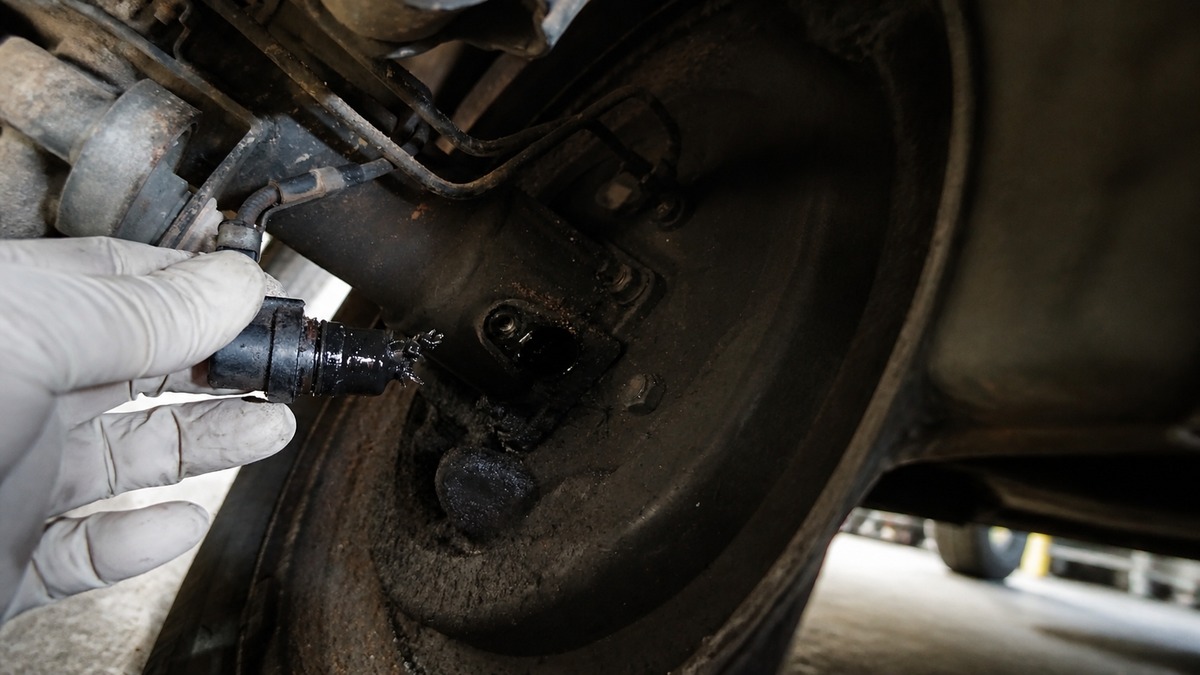
- A failed or contaminated wheel speed sensor. These sit low down near the wheels, exposed to water, grit and heat.
- Damaged wiring or a corroded connector at the wheel, where the harness flexes every time the suspension moves.
- A damaged or dirty tone ring, the part the sensor reads. On some cars that is a toothed metal ring, on others a magnetic encoder built into the wheel-bearing seal. Rust, packed mud, a missing tooth or a damaged magnetic track all give the module a signal it cannot trust.
- A worn wheel bearing, which lets the hub move enough to upset the gap between the sensor and the ring. If you also have a hum or rumble that changes with speed, our guide on wheel bearing noise is worth reading.
- Low brake fluid or an air or hydraulic fault in the braking system.
- A supply, earth or fuse problem feeding the ABS unit.
- A fault inside the hydraulic modulator or the control module itself.
How a workshop diagnoses an ABS fault
Order matters, because guessing at ABS parts is expensive.
- Confirm the symptoms and the exact lights. Which warnings, when they appear, whether they clear on restart, and how the brakes feel.
- Check the basics first. Fluid level and condition, leaks, brake wear and tyre condition, since mismatched or badly worn tyres can upset wheel speed comparison.
- Scan the ABS module and read the stored fault codes and freeze frame data, which narrows the search to a corner or a circuit.
- Compare live wheel speed data while the wheels are turned. A sensor that reads zero, drops out or reads erratically against the other three is better evidence than the code alone.
- Inspect the suspect corner physically. Sensor face, tone ring condition, connector, harness routing and bearing play all get checked.
- Test the circuit rather than assume it, using the method that suits the sensor. Active and passive wheel speed sensors are not tested the same way, so the supply, signal, resistance or oscilloscope checks come from the manufacturer’s system information for that vehicle. Done properly, that separates a failed sensor from a broken wire feeding a healthy one.
- Only then decide on a repair, and retest the system afterwards to confirm the fault is gone and not simply cleared.
Steps five and six are where a fair number of ABS jobs turn out to be wiring rather than the part the code named. That is why this work belongs with proper car diagnostics rather than a code reader in a parts shop car park.
Why the fault code on its own is not the answer
A code such as a right front wheel speed sensor fault does not prove the sensor failed. It says the module is not getting a sensible signal from that circuit, and the cause can be the sensor, the wiring, the connector, the tone ring, the bearing or the module input.
Clearing a code does not repair the cause. The warning and the code usually return as soon as the system detects the fault again, so the car should be retested after the repair before the anti-lock system is trusted.
What decides the repair and the cost
There is no single price for an ABS fault, because the jobs behind that one amber light are not comparable. What moves the number is which part has actually failed, how much has to come apart to reach it, whether the car needs a hub or bearing assembly rather than a sensor alone, and parts availability for your make and model.
So the diagnosis comes first, then the quote. A workshop pricing an ABS repair over the phone, before seeing the car and the live data, is guessing.
Book an ABS check at Fangio Auto
If you are searching for abs brake repair near me, Fangio Auto has two workshops, and both approach an ABS warning the same way: symptoms and lights first, then live wheel speed data, then a repair decision.
Tell us the make, model and year, which warning lights are on and what the brakes feel like, and we will book a proper brake repair assessment rather than a parts guess. If the car is unsafe to drive, say so when you call and we will talk through your options first.
Fangio Auto Randburg, repairing brakes in Blairgowrie since 2009.
- Phone 011 326 3133
- WhatsApp 082 402 3517
- 110 Susman Ave, Blairgowrie, Randburg
- Monday to Friday, 07:30 to 16:30. Closed Saturday, Sunday and public holidays.
Fangio Auto Hermanus, in Hermanus Industrial since 2021.
- Phone 087 164 1041
- WhatsApp 060 616 2948
- 13A Steenbras Road, Hermanus Industrial
- Monday to Friday, 08:00 to 17:00. Closed Saturday, Sunday and public holidays.
Not sure which branch suits you, or want to ask before you book? Contact us and we will point you to the right workshop. Johannesburg drivers can also read more about our car repairs in Randburg.
Frequently asked questions
Do my normal brakes still work with the ABS light on? Usually yes. Everyday braking is separate from the anti-lock function, so the car still stops, but without the anti-lock help during a hard stop, and on some vehicles other linked functions can drop out too. If the pedal feel has changed or a red brake light is on as well, do not rely on that assumption.
Can I just reset the ABS light? You can clear the code, but that repairs nothing. If the cause is still there, the warning and the code come back when the system next detects the fault. Find the cause, repair it, then retest the car before you trust the system.
Can low brake fluid or worn brake pads bring on the ABS light? They are different things. Low brake fluid is normally a red brake warning issue, and on some vehicles it can disable the anti-lock function too. Worn pads are not a normal direct cause of an ABS fault, though a car with linked pad-wear monitoring, a wiring fault or another brake-system problem can show more than one warning at once. That is why fluid and brake condition are checked before anything is replaced.
Can a wheel bearing cause an ABS fault? Yes. A worn bearing can let the hub move enough to disturb the sensor reading at that corner. If a hum or rumble that changes with road speed came before the light, mention it when you book.
Is it worth fixing if the car still stops? Yes. The anti-lock system is there for the emergency stop you have not had yet, and on many vehicles it also underpins traction and stability control. Driving with it switched off means the car is missing help exactly when a wet road needs it most.
Already have a quote?
Get an honest second opinion
Send it over and we’ll review it, explain it plainly, and beat it where we can.